

Meet us at iFx Cyprus
The prop trading industry is expanding rapidly, creating opportunities for entrepreneurs to launch their own firms. Building a proprietary trading operation from scratch involves complex trading platforms, risk management systems, and regulatory frameworks that can drain budgets and delay launches by months. Understanding what distinguishes robust white-label solutions from problematic ones determines whether new ventures succeed or struggle in this competitive market.
Successful prop firm launches require reliable technology partners that handle infrastructure complexities while allowing founders to focus on growth. The right white-label provider manages everything from trader evaluation systems to payout processing, eliminating technical headaches that typically slow down new ventures. For entrepreneurs ready to enter the market efficiently, Trade Tech Solutions offers comprehensive prop firm technology designed specifically for quick, profitable launches.
A white label prop trading solution is pre-built infrastructure you license and rebrand as your own. It includes the trading platform, trader evaluation system, CRM, risk management tools, payout workflows, and compliance frameworks. You control the brand, pricing, rules, and trader experience, while the technology provider maintains the backend systems, servers, liquidity connections, and software updates.
Most people think launching a prop firm is primarily a technology and branding problem: pick a platform, set challenge rules, and attract traders. This belief persists because white-label providers make it appear effortless to implement and launch.
This assumption falls apart when real market stress happens.
A clear example is the 2023 regulatory action against MyForexFunds, in which concerns about payout practices and trader funds handling led to a shutdown. Industry analysis identified a consistent core issue: liquidity management and payout obligations were misaligned with trader behavior during volatility cycles.
According to industry commentary from providers such as Leverate and B2BROKER, firms typically underestimate correlated trader profitability in trending markets, payout clustering risk after evaluation phases, and reserve requirements during volatility spikes.
This creates false stability during early growth because early-stage firms see evaluation revenue without synchronized payout exposure, which emerges months later when funded traders scale simultaneously.
When multiple traders pass challenges in the same market regime, withdrawals cluster in the same window, exposing liquidity gaps most operators never planned for. This is why white label infrastructure became the default entry point: it shifts operational risk from engineering to configuration rather than removing complexity.
Understanding how that shift works separates sustainable firms from short-lived launches.
Understanding white label means recognizing two distinct roles. The tech provider owns and maintains the infrastructure: building the platform, hosting servers, integrating liquidity providers, and pushing updates. The operator owns the brand and carries business risk: funding trader accounts, setting profit targets and drawdown limits, designing marketing campaigns, and managing customer support. This separation defines where your work begins.
When Leverate examined how prop firms generate revenue in March 2025, they found that companies cut development costs by 70% using white label infrastructure instead of building proprietary systems. This approach eliminated expenses for in-house developers to maintain evaluation logic, vendor negotiations for payment systems and compliance tools, and server management during peak trading periods.
The operator layer is where differentiation happens. Two firms can license the same white label platform and create completely different trader experiences. One might target conservative forex traders with 8% profit targets and 5% drawdowns; another might chase aggressive scalpers with 10% targets and 12% drawdowns. Same infrastructure, different rules, different branding, different risk appetite. Our platform removes technical barriers preventing you from executing your business model.
White label providers handle system maintenance (typically 99.9% uptime), API integrations with MetaTrader 4, MetaTrader 5, and cTrader, and payouts via wire transfers, crypto wallets, and payment processors. According to B2BROKER, operators using white-label solutions launch funded trading in weeks, rather than the six to twelve months required for custom development.
That speed matters because market windows close fast. If you see demand for crypto prop trading, waiting a year for custom development means competitors will claim that audience first. White label infrastructure lets you test business models quickly: launch a two-phase evaluation system in March, see if traders respond, adjust profit splits in April based on actual pass rates. The platform adapts to your strategy rather than forcing your strategy to fit its limitations.
Speed creates value only if the infrastructure can withstand the pressure. Traders expect instant order execution, real-time performance tracking, and transparent payout schedules. If your provider's servers slow during volatile markets or risk management tools fail to enforce drawdown limits, your brand suffers reputational damage. The provider's technical competence directly impacts your ability to retain traders and grow revenue.
But infrastructure solves the technical problem, not the business problem.
Many people think white label prop firms are a quick way to make money. They're not. Making money isn't about the platform: it's about how you design risk models, structure evaluation challenges, and control payout liability. The infrastructure lets you run operations, but the business model determines whether you survive or lose capital within six months.

🎯 Key Point: The technology platform is just the foundation—your profitability depends entirely on how you structure trader evaluations, manage risk exposure, and control capital outflows.
"The infrastructure lets you run operations, but the business model determines whether you survive or lose capital within six months."
⚠️ Warning: Most new prop firm operators focus on the wrong metrics. They obsess over platform features while ignoring the critical factors that determine long-term viability: risk management protocols, payout structures, and trader screening processes.
Your evaluation pass rate directly controls related payout risk. Setting challenge rules too loosely causes too many traders to pass simultaneously, creating liquidity stress when multiple funded accounts hit profit targets in the same market cycle.
Poor evaluation design leads to high payouts, which creates liquidity stress and business instability. You fix this by understanding how pass rates, drawdown thresholds, and profit targets work together across different market conditions.
Payout liability control matters more than most operators expect. If your failure rate distribution skews toward experienced traders gaming lenient rules, you're running an unhedged brokerage with all the downside and none of the upside.
Spend $200 per funded trader with a 15% pass rate and 60% of those traders withdrawing profits within 90 days: your unit economics collapse before reaching scale.
For Traders projects, the prop firm market will reach $12 billion in 2025, though this growth masks the fact that many operators lack an understanding of their break-even dynamics.
High trader volume doesn't save you if each group costs more to fund than it makes in evaluation fees and kept capital. Volume accelerates failure when the model is structurally unsound.
Think of it like underwriting insurance policies without actuarial data. You collect premiums (evaluation fees), but you don't know your true loss ratio until claims (payouts) hit. If you've mispriced risk, you discover it when multiple funded traders withdraw simultaneously during a volatile week. That's not a technology problem: it's a business design problem.
Platforms like prop firm technology provide tools to enforce drawdown limits, automate risk controls, and manage payout workflows, but they cannot fix a fundamentally broken risk model. The software executes your rules. You must set the right ones.
Payout variance sensitivity means a single week of correlated wins can wipe out months of evaluation revenue if your reserve ratios are too thin. Most operators model profitability based on average trader behavior, rather than clustered outcomes in trending markets.
When 40 funded accounts hit their profit targets in the same three-day rally, your liquidity needs spike. Without capital reserves or hedging strategies for that scenario, you're gambling, not operating.
Knowing the mechanism doesn't tell you which providers actually help you build a sustainable model rather than just selling you access to trading infrastructure.
Choosing a provider isn't about finding the "best" platform—it's about matching your operational model, asset focus, and growth timeline to infrastructure built for those specific constraints. Some providers excel at rapid deployment for forex-only firms testing market demand. Others prioritize multi-asset flexibility or enterprise-grade customization for operators managing proprietary risk models at scale.

🎯 Key Point: The right provider depends entirely on your business model, target assets, and scaling timeline—not industry rankings or popularity.
The decision comes down to understanding what each provider specializes in, who benefits most from their infrastructure, and when their system becomes the wrong fit for your growth trajectory.
"Success in prop firm launches isn't about choosing the most popular platform—it's about matching infrastructure capabilities to your specific operational requirements and scaling timeline." — Industry Analysis, 2024
💡 Tip: Focus on provider specialization rather than feature lists—a forex-optimized platform will always outperform a generalist solution for currency-focused operations.

Trade Tech Solutions provides technology for prop firms, including a CRM with trader dashboards, advanced risk management tools, payout workflows, detailed analytics, and trader retention tools. Over 90 prop firms worldwide trust the company, which built its infrastructure on real experience from within the prop trading industry.
White-label technology solutions for prop trading firms, including trader dashboards, challenge management systems, payout tracking, affiliate management tools, CRM integration, account monitoring, and operational analytics designed for prop firm workflows.
Operators needing customizable configurations that support unique challenge structures, drawdown rules, scaling plans, payout models, and trader restrictions without rigid templates.
Companies requiring specialized evaluation methods or custom-built risk systems outside standard prop firm workflows, or large businesses with unique compliance needs, may need to build infrastructure from the ground up rather than adapt a white-label foundation.
The platform includes automation tools for trader onboarding, operational management, and backend administration, along with multi-platform integration support and payment system connectivity, helping firms manage growing trader activity efficiently.
FPFX Tech is a prop firm technology provider specializing in infrastructure for proprietary trading firms. They offer challenge management tools, funded account infrastructure, CRM systems, trader dashboards, affiliate management, payout systems, and risk monitoring tools designed for evaluation-based funding models. Their ecosystem includes FundingPips Technology infrastructure support and trader lifecycle management.
Firms seeking automation to help traders advance, follow account rules, scale systems, and manage daily operations. Operators requiring integrated systems for evaluation-based funding models will find Tech Trade's infrastructure well-suited to their needs.
Firms using funding models that are not based on evaluations or that require extensive customization for unusual challenge structures may find the platform lacks sufficient flexibility. Operators needing to trade beyond forex and CFDs require broader infrastructure.
Brokeree's Prop Pulse focuses on prop trading operations and trader account management within MetaTrader environments. It enables brokerages and prop firms to launch challenge-based funding programs through automated account monitoring, trader progression systems, and risk management controls.
Automated challenge verification, rule monitoring, progression tracking, and funded account management based on trader performance and predefined challenge requirements. The system integrates with MetaTrader 4 and MetaTrader 5, which are widely used across forex and CFD prop trading firms globally.
Companies that manage multiple evaluation accounts simultaneously and require centralized risk controls, trader analytics, and operational monitoring will benefit from this solution. Operators working deeply within MetaTrader ecosystems will benefit most from Prop Pulse's tight integration.
Companies operating outside MetaTrader environments or requiring support for multiple platforms may find the infrastructure limiting. Operators that need extensive customization of challenge logic or payout structures require more flexible systems.
Axcera is a financial technology company that provides behind-the-scenes technology for prop firms, brokerages, and trading businesses. They offer a customizable white-label platform that covers trader onboarding, challenge management, account administration, CRM integration, payment systems, and operational management.
Customization and scalability. Prop firms with different funding models require flexibility in challenge rules, payout structures, trader evaluations, and risk controls. Axcera automates operations to reduce manual administrative work as firms grow.
Businesses that need a centralized system to manage multiple operational functions will benefit from this solution. Operators seeking flexibility in funding and success metrics will find Axcera easier to use than rigid, template-based systems.
Companies that need to get something up and running quickly without extensive setup might find that the customization process takes longer than with ready-made alternatives.
Leverate is a well-known company that provides technology for brokerages, offering trading platforms, CRM systems, client portals, risk management tools, payment integration, affiliate systems, and operational automation for brokerages and prop firms.
Multi-asset infrastructure supporting forex, CFDs, crypto, commodities, and indices based on their operational model.
Established operators expanding asset coverage or firms launching multi-asset strategies from inception. Businesses requiring enterprise-grade infrastructure with deep liquidity integration.
Smaller firms testing forex-only models may find Leverate's infrastructure overly complex and expensive. Operators prioritizing simplicity and rapid deployment over multi-asset flexibility might benefit from more streamlined providers.
YourPropFirm provides entrepreneurs with a complete solution for entering the prop trading market. It has helped clients generate over $45 million in revenue, establishing it as a significant player in the industry.
YourPropFirm specializes in a fully managed turnkey approach that handles technology infrastructure, payment systems, and brand control. The platform supports FX, CFDs, and futures trading via Rithmic (as of April 2025).
Core features include a centralized dashboard and CRM for real-time monitoring, customizable branding and website development, integrated payment processing supporting cryptocurrencies, credit cards, and bank transfers, automated subscription billing, and advanced rule enforcement.
YourPropFirm is best for entrepreneurs seeking rapid launch. The platform can establish a new prop trading firm in as little as four weeks. It's no revenue-sharing model; it lets firms retain 100% of profits, appealing to operators who want full control over their margins.
Companies requiring highly customized evaluation structures or proprietary risk models may find the turnkey approach too rigid. Operators needing substantial backend control or unique challenge logic should consider more flexible providers.
Quadcode WL Prop combines trading technology and back-office management in a single white-label system, integrating a next-generation trading platform with a marketing-focused CRM.
Foreign exchange and cryptocurrency trading with one-click trading, leverage options, up to 9 charts, and over 100 technical indicators. Back-office tools manage customers, administrators, and Introducing Brokers (IBs), featuring global KYC integration and ticket-based support.
Companies seeking to simplify trading and administrative tasks with support for two asset types. Advanced trading tools and complete back-office management make it ideal for prop firms looking to expand their trader base and strengthen their brand.
Operators needing support for multiple asset types beyond forex and crypto, or firms requiring extensive customization of challenge structures and evaluation logic.
Eightcap Partners provides a white-label broker solution, allowing you to maintain your brand while leveraging an established platform rather than building one from scratch.
White-label broker solution for proprietary trading firms supporting Forex (FX) and Contracts for Difference (CFDs). The platform integrates seamlessly with MT4 and MT5, providing access to strong liquidity through institutional channels and funding integrations.
Proprietary trading firms seeking to focus on recruiting traders and building their brand without managing technical development.
Firms needing extensive customization of challenge structures or evaluation logic, or those requiring multi-asset support beyond forex and CFDs.
Match-Trader is a complete trading solution built in-house for Forex brokers and proprietary trading firms. It functions as a white-label platform, either as a standalone platform with its own CRM or as backend technology for custom front-ends.
Match-Trader specializes in Forex (FX) and Contracts for Difference (CFDs) with access to deep liquidity via Match-Prime Liquidity. The Prop Trading Platform module includes built-in challenges, account dashboards, and a Prop CRM for managing funded accounts, efficiently handling up to 100,000 accounts.
Match-Trader suits growing proprietary trading firms seeking advanced charting tools and mobile-focused trading. The platform won 'Outstanding Proprietary Trading Platform' and 'Exceptional Technology and Infrastructure in Proprietary Trading' at Finance Feeds Awards 2024. TradingView charts are included at no additional cost.
Match-Trader may not suit firms requiring support for multiple asset types beyond forex and CFDs, or those needing deeply custom evaluation logic and risk systems.
Ryan Beasley, Founder & CEO of Propriotec, noted: "Match-Trader is one of the easiest platforms we've integrated into our CRM. The API is clean, setup is smooth, and it's rock-solid once live. For prop firms, the setup removes launch friction. Fast to deploy, easy to scale, and plays well with our system."
DXtrade, developed by Devexperts, has earned recognition as the "Best Software for Trading Cryptocurrency." This multi-asset, broker-agnostic platform offers white-label services tailored to specific business needs.
Multi-asset support including stocks, derivatives, forex, CFDs, spread betting, and cryptocurrencies. DXtrade handles trading operations with precision and scalability, adapting to firms' evolving needs as they expand asset offerings and operations.
Enterprise-level proprietary trading firms need scalable, customizable solutions for multi-asset trading. Operators requiring extensive asset coverage will find DXtrade's infrastructure more robust than that of single-asset providers.
Starting a prop firm using white label infrastructure follows a strict causal sequence, not a checklist. Each decision determines what becomes possible next. Step 1 (jurisdiction and operator structure) sets regulatory boundaries and payment processing viability. Step 2 (risk model definition) determines whether your firm survives payout variance. Step 3 (evaluation rule configuration) shapes the trader distribution curve that drives your profit engine. Step 4 (payout and liquidity logic) determines cash flow resilience under real market conditions. Step 5 (live calibration) aligns your theoretical model with actual trader behavior. Skip a step or reverse the order, and you build on unstable ground.

🎯 Key Point: The sequential nature of prop firm setup means that each foundational decision creates constraints and opportunities for every subsequent choice - there's no going back without high cost.
"85% of prop firm failures occur within the first 12 months due to inadequate risk management frameworks and poor liquidity planning." — Proprietary Trading Industry Report, 2024
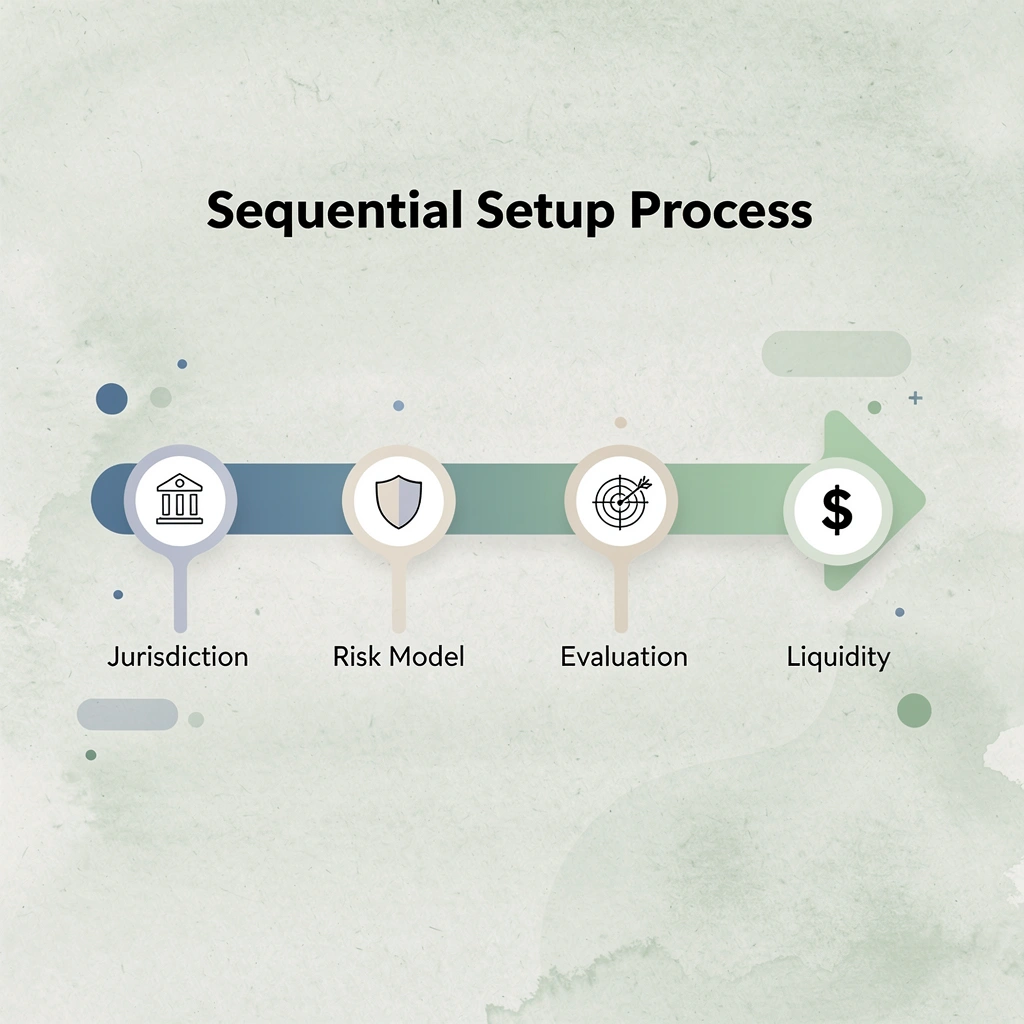
⚠️ Warning: Rushing through the jurisdiction selection or choosing an inadequate risk model will create cascading problems that become exponentially more expensive to fix once traders are active on your platform.
The first choice is not your dashboard's color scheme, but where you operate and how you structure your business. Jurisdiction determines tax obligations, regulatory requirements, and compatibility with payment processors. An operator launching from a jurisdiction with unclear prop trading regulations will face payment gateway rejections, banking friction, and compliance exposure. According to Spotware, the proprietary trading market is projected to reach $12.5 billion by 2028, though growth concentrates in jurisdictions with clear legal frameworks. Choosing the wrong location creates structural barriers that no marketing budget can overcome.
Most operators pick challenge parameters (daily loss limits, profit targets, time windows) based on competitor offerings, then hope the math works. The sustainable approach starts with risk modeling: how much capital can you allocate per funded trader? What correlation exists between trader payouts during volatile market periods? What pass rate and withdrawal rate combination keeps your revenue-to-payout ratio stable? Once you answer these questions, your evaluation rules follow logically. A firm that skips this step ends up with loose challenge rules that look attractive but generate correlated payouts during trending markets. When multiple funded traders hit profit targets simultaneously, liquidity stress becomes existential rather than theoretical.
Step 3 is where you design the trader distribution curve. Evaluation rules determine how many traders pass, how quickly they scale, and what behavior patterns emerge. A 10% pass rate with strict daily drawdown limits creates a different profit engine than a 20% pass rate with trailing drawdowns. The former generates more challenge revenue with lower payout liability; the latter attracts more skilled traders but requires tighter risk monitoring. Our prop firm technology enables full customization of multi-phase evaluation logic, daily loss limits, and scaling triggers, allowing you to configure challenge structures that align with your Step 2 risk model rather than accepting generic templates. Create evaluation structures that produce a trader distribution curve your capital base can sustain.
Step 4 is where cash-flow strength is tested. You need payout automation that executes on your terms while maintaining audit trails and fraud detection. Manual processes create mounting work as trader numbers grow, but automation without sound liquidity planning accelerates insolvency. Your payout logic must account for withdrawal timing, minimum balance thresholds, and correlation stress scenarios.
A firm processing $50,000 in weekly payouts with only $75,000 in operating capital has no buffer when multiple traders withdraw simultaneously. Sustainable firms connect payout workflows directly to their Step 2 risk model, ensuring liquidity reserves match worst-case payout scenarios rather than average-case projections.
Step 5 is where theory meets reality. Your initial risk model and evaluation rules remain hypotheses until live traders interact with them. A real launch requires monitoring pass rates, withdrawal rates, rule-violation patterns, and payout timing in real time.
A firm targeting a 15% pass rate that sees 25% has misconfigured Step 3. A firm expecting a 60% withdrawal rate that observes an 80% rate has underestimated Step 4 liquidity needs.
Continuous calibration is not optional: it is the difference between firms that survive their first six months and those that do not.
Infrastructure alone does not determine whether your firm survives its first payout cycle or scales past six figures in monthly revenue.
Using a white label provider fixes the platform problem, but not the operational architecture problem. Firms that grow past their first year know that infrastructure means connected systems for trader acquisition, risk monitoring, payout execution, retention mechanics, and the data pipelines that connect them. When those systems work independently or require manual coordination, growth creates operational debt faster than revenue can cover it.
Before launching or scaling a prop firm, validate whether your model can survive real payout conditions, not launch conditions.
What you get:
Time required: under 5 minutes to submit your firm model details. Output: a structured risk and infrastructure readiness report you can act on immediately
Start here: prop firm technology and confirm your evaluation design, payout logic, and infrastructure stack are aligned before trader volume exposes structural weaknesses.


.png)
