

Meet us at iFx Cyprus
Talented traders often face a common dilemma: they possess profitable strategies but lack sufficient capital to maximize their earning potential. Personal trading accounts can severely limit profit opportunities, regardless of skill level. Proprietary trading firms offer a solution by providing funding to qualified traders, allowing them to scale their operations without risking personal wealth.
These firms evaluate traders through structured assessment programs and provide access to substantial capital for those who demonstrate consistent profitability. The best proprietary trading firms combine fair evaluation processes with robust risk management systems and competitive profit-sharing arrangements. Prop firm technology creates the infrastructure that connects skilled traders with legitimate funding opportunities while ensuring transparent pathways to capital.
You develop a profitable strategy, backtest it, refine your entries, and start trading live. The win rate looks good. The execution feels clean. But after months of consistent effort, your account grows from $500 to $800. The math is right, but the returns feel small.
🎯 Key Point: Even with a solid strategy and good execution, retail traders face the fundamental limitation of small account sizes that cap their earning potential.
"Strategy without scale, skill without capital to make it matter - this is retail trading's main problem that keeps profitable traders stuck in low-dollar gains."
⚠️ Warning: Many traders mistake small account growth for strategy failure when the real issue is insufficient capital to generate meaningful returns from their proven edge.
Account Size
$500
Monthly Return
10%
Dollar Gain
$50
Account Size
$50,000
Monthly Return
10%
Dollar Gain
$5,000
Account Size
$500,000
Monthly Return
10%
Dollar Gain
$50,000

Most traders believe depositing more money or using higher leverage solves this: save another $2,000, increase position sizes, compound faster. But capital accumulation is the real bottleneck when starting small. Even doubling a $200 account every few months—a pace most traders can't sustain—leaves you years away from generating meaningful income. According to For Traders, prop trading reached a $12B market in 2025, largely because traders realized personal capital accumulation wasn't viable for professional-level returns.
This belief exists because retail trading culture celebrates account flipping. Social media highlights the trader who turned $100 into $10,000, not the one who built a systematic edge over three years with data. A 50% monthly return feels like progress until you realize that's $100 profit on a $200 account. You can't pay rent with percentages. The emotional high of a winning week masks the core problem: small capital means small absolute returns, regardless of strategy quality.
Traders also misunderstand capital efficiency. Leverage amplifies losses as aggressively as gains, and a single bad week can erase months of careful growth. I've watched traders exhaust dozens of funded challenges, forcing quick wins rather than accepting that their sound strategy cannot generate meaningful income at $500. The pressure to grow faster leads to over-leveraging, blowups, and process resets.
Slow account growth creates emotional pressure that distorts decision-making. You take trades outside your system because waiting for proper setups feels too slow, and you increase position sizes prematurely because the math suggests you need bigger wins to reach your goals within a reasonable timeframe.
The strategy that worked in the demo, where there was no pressure, breaks down under financial pressure. You're trading your frustration with slow compounding on a small base, not your edge.
Over-leveraging becomes the way to compensate for losses. If a 2% risk per trade feels too safe, you can push it to 5% and then 10%. Higher risk accelerates growth, but it creates a fragile system in which a normal losing streak wipes out months of progress.
You can't scale a winning strategy when the foundation is built on excessive risk.
Proprietary trading firms solve this structural problem by providing capital that turns profitable strategies into scalable income, eliminating years of compounding small personal accounts. Instead of waiting to save $10,000 while working another job, traders can access $50,000 or $100,000 in funded capital by proving their strategy works under evaluation conditions.
The firm handles capital risk, the trader focuses on execution, and profits are split according to pre-agreed terms. Our prop firm technology builds the infrastructure for this model at scale, creating transparent evaluation systems and risk management tools that protect both traders and firms.
The core question is how prop firms convert trading skill into sustainable, scalable returns without the capital constraints that trap retail traders.
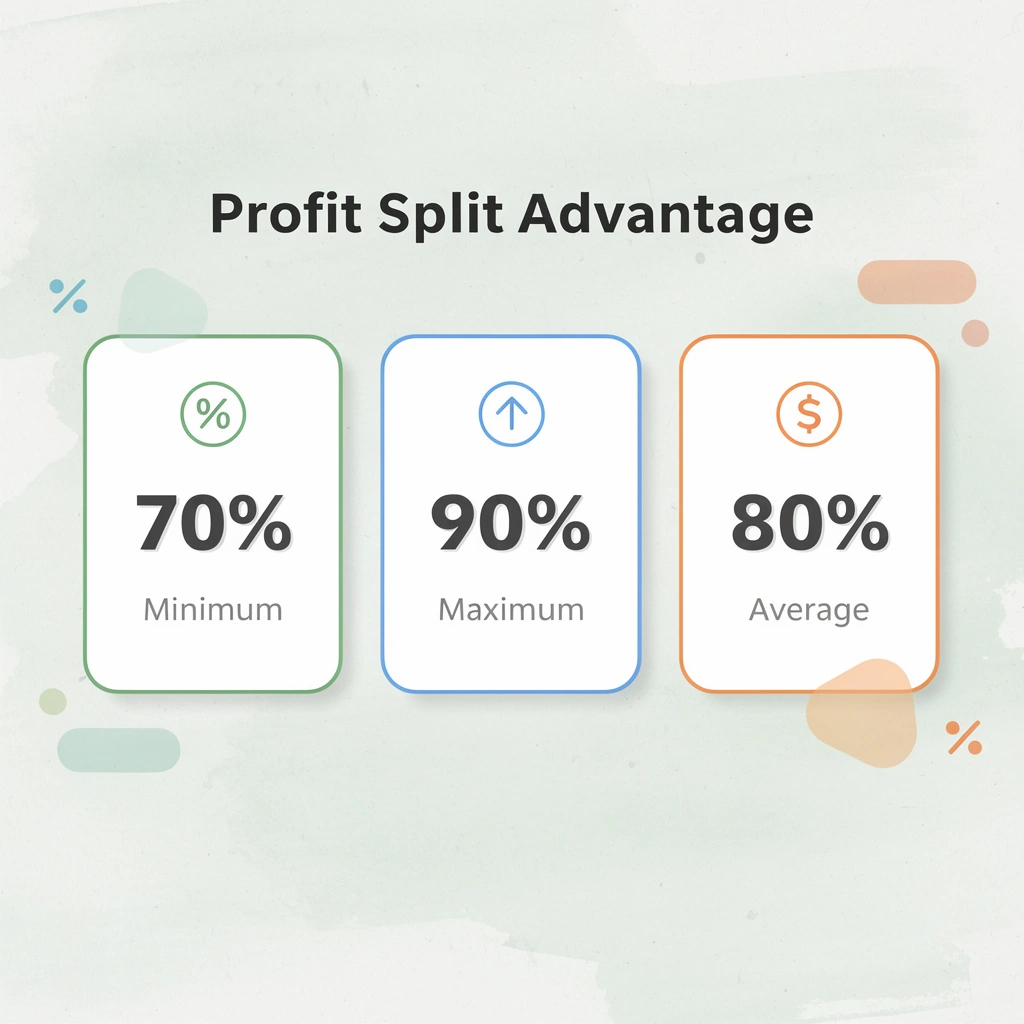
Proprietary trading firms turn skill into money through structured evaluation systems that measure how consistent you are, not how well you predict the market. You prove you can manage risk across multiple trades, stay within drawdown limits, and reach profit targets while adhering to position sizing rules. Once you demonstrate controlled execution, the firm provides real capital to trade with and splits profits with you, typically 70-90% in your favor.

"Proprietary trading firms typically offer profit splits of 70-90% in favor of skilled traders who demonstrate consistent risk management."
🔑 Key Point: The evaluation process focuses on risk management consistency rather than raw profit generation, making it accessible to traders who prioritize controlled execution over high-risk speculation.
💡 Tip: Success in prop firm evaluations comes from proving you can follow strict risk parameters while maintaining steady profitability, not from hitting home runs on individual trades.
The challenge phase identifies traders who follow a risk framework under pressure, not those who predict markets perfectly. You'll face profit targets (often 8-10% of account value), maximum daily loss limits (typically 5%), and total drawdown caps (usually 10%). Miss any threshold, and you're eliminated, regardless of prior winning trades.
The metrics are unforgiving: a single overleveraged position hitting your daily loss limit can erase a month of disciplined work. Firms simulate what happens when managing institutional money. One catastrophic loss can erase weeks of gains, and they need proof you won't let that happen.
Prop firms don't give capital to anyone who passes a test. They spread risk across hundreds of traders simultaneously, profiting whether you win or lose. Challenge fees (usually $100–$500 per attempt) generate revenue even when traders fail. When you succeed, they take 10-30% of your profits while risking none of their own money on your losing trades.
According to Leverate's analysis of prop trading opportunities for 2025, companies can grow capital from thousands to millions based on trader performance, but only after traders demonstrate consistent results across many trades. The evaluation phase filters out traders who confuse luck with skill. Companies need traders who can repeat their results when market conditions change, not those who make one exceptional trade and assume they have mastered trading.
Skill alone doesn't unlock capital. You demonstrate skill through risk control (position sizing, stop placement, drawdown management), which qualifies you for initial funding (usually $5,000–$25,000). Maintain that discipline with real capital, and firms increase your allocation, sometimes reaching six or seven figures.
Larger capital multiplies absolute profit from the same percentage returns, but only if your risk management scales proportionally.
The breaking point occurs when traders confuse passing an evaluation with understanding the system. You might trade perfectly during a 30-day challenge, then loosen your risk controls once funded.
Platforms like prop firm technology track every metric in real time, creating transparency that protects both sides. Our Trade Tech platform helps traders see exactly where they stand relative to thresholds, and firms identify who maintains discipline when the pressure shifts from proving capability to preserving capital.
But not all firms enforce these systems the same way, and that's where frustration turns sharp.
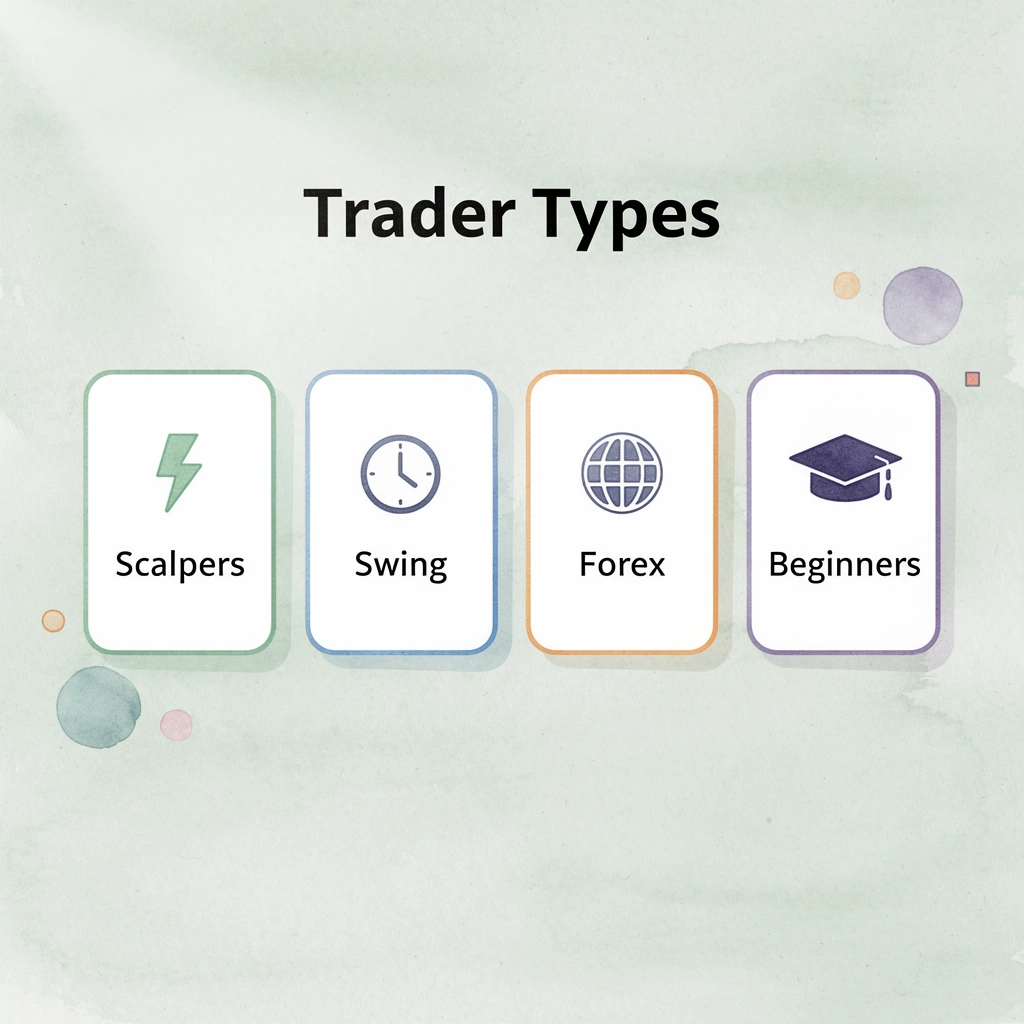
Not all proprietary trading firms serve the same trader. Some focus on futures scalpers who need fast execution and minimal drawdown restrictions. Others work with swing traders managing forex positions across multiple days, or beginners who need forgiving evaluation structures while they develop consistency. The firm that works for a veteran algorithmic trader will frustrate someone learning discretionary price action, and vice versa.

The difference isn't in features. It's how each firm's funding model, risk parameters, and profit structure align with your trading behavior. A 10% profit target with 5% drawdown might sound reasonable until you realize your strategy needs 8% breathing room to survive normal volatility. A 90% profit split means nothing if payout delays or hidden fees erode what you take home. According to Prosper Trading Academy's analysis of the 12 best prop trading firms, the gap between marketing promises and operational reality separates firms' traders' recommendations from those they warn others to avoid.
🎯 Key Point: Firm selection should match your specific trading style, risk tolerance, and experience level rather than generic "best of" rankings.
"The gap between marketing promises and operational reality separates firms traders recommend from those they warn others to avoid." — Prosper Trading Academy Analysis
What follows is a diagnostic framework. Each firm below solves a specific problem for a specific type of trader.
💡 Tip: Before choosing any firm, calculate whether their drawdown limits align with your strategy's historical volatility patterns and maximum expected losses.

People starting or growing their own trading business, rather than individual traders seeking capital.
Most prop firm owners cobble together systems from different companies: one for CRM, another for risk monitoring, a third for payouts, and a fourth for compliance in spreadsheets. Each integration creates friction: data mismatches, conflicting dashboards, and mounting operational overhead as trader volume grows. Manual reconciliation tasks consume hours daily.
Trade Tech provides the foundation to stop this fragmentation. Our platform brings together CRM, trader dashboards, risk management, payout workflows, analytics, and retention systems into one workspace.
Trusted by over 90 prop firms worldwide, Trade Tech's technology is built from real operating experience inside the industry. When evaluation metrics, payout triggers, and risk thresholds operate within a single system, firm owners shift their focus from managing technical complexity to growing their business. Our prop firm technology compresses the operational distance between identifying a promising trader and allocating capital to them, while maintaining the transparency both sides need to trust the relationship.
An all-in-one infrastructure eliminates integration headaches, provides unified data visibility, and scales operational efficiency as trader volume increases.
This is enterprise-level infrastructure for firm operators, not a funding program for individual traders.

Traders seeking flexible challenge structures who are comfortable with a newer company still building its operational track record.
Single Helix, Double Helix, and Pro Challenge pathways offer account sizes from $5,000 to $200,000, with entry fees ranging from $49 to $1,451 depending on challenge type.
80% standard, scalable to 90% with add-ons.
Removing time limits on evaluation eliminates pressure to force trades within arbitrary deadlines. Backed by Eightcap for liquidity, the platform provides institutional-grade execution quality.
The $49 entry fee makes this accessible for traders testing prop firm models without significant upfront investment. Automated trading systems (EAs) are permitted, giving algorithmic traders freedom to deploy their strategies.
Pre-launch status means there is no operational track record. Double Helix carries higher drawdown exposure, and cryptocurrency trading is excluded from Pro Challenge accounts, limiting tradeable asset types.

Traders who prefer live account evaluation over demo-based challenges and seek free entry to capital allocation.
A six-stage progression starting with a $500 minimum deposit seed account. Traders advance based on performance metrics tracked through our proprietary Edge score system, with capital scaling up to $1 million USD.
Up to 90%.
5% profit target per stage, below industry average and reducing participant pressure. Live trading from day one ensures execution quality and slippage match real market conditions.
Zero joining fees remove financial barriers. Live account structure provides a realistic trading experience, showing actual fills and latency that demo simulations cannot replicate.
The edge score calculation method isn't publicly shared, creating unclear advancement criteria. The $500 minimum deposit is lower than competing firms' challenge fees but remains a barrier for some traders.

Conservative traders who prioritize capital preservation and can adjust their success metrics.
You can choose a preset 2-step or 3-step evaluation with an 8% profit target in phase one and 4% in phase two. Custom evaluations allow traders to set the starting balance, drawdown limits, and payout share, though fees are significantly higher.
80% on preset programs, negotiable on custom evaluations.
An 8% maximum drawdown matches the phase one profit target, creating a balanced risk-reward structure. No time limits allow traders to wait for optimal setups rather than forcing activity.
You can customize how the evaluation works, allowing experienced traders to adjust risk parameters to align with their strategies. However, premium fees apply.
The profit targets are conservative, and the drawdown limits closely match them, leaving little room for strategies that require wider stop-loss levels. Custom programs carry high entry costs, making them inaccessible for many traders. All trading occurs on demo accounts even after funding, which some traders view as less realistic than trading with actual money.
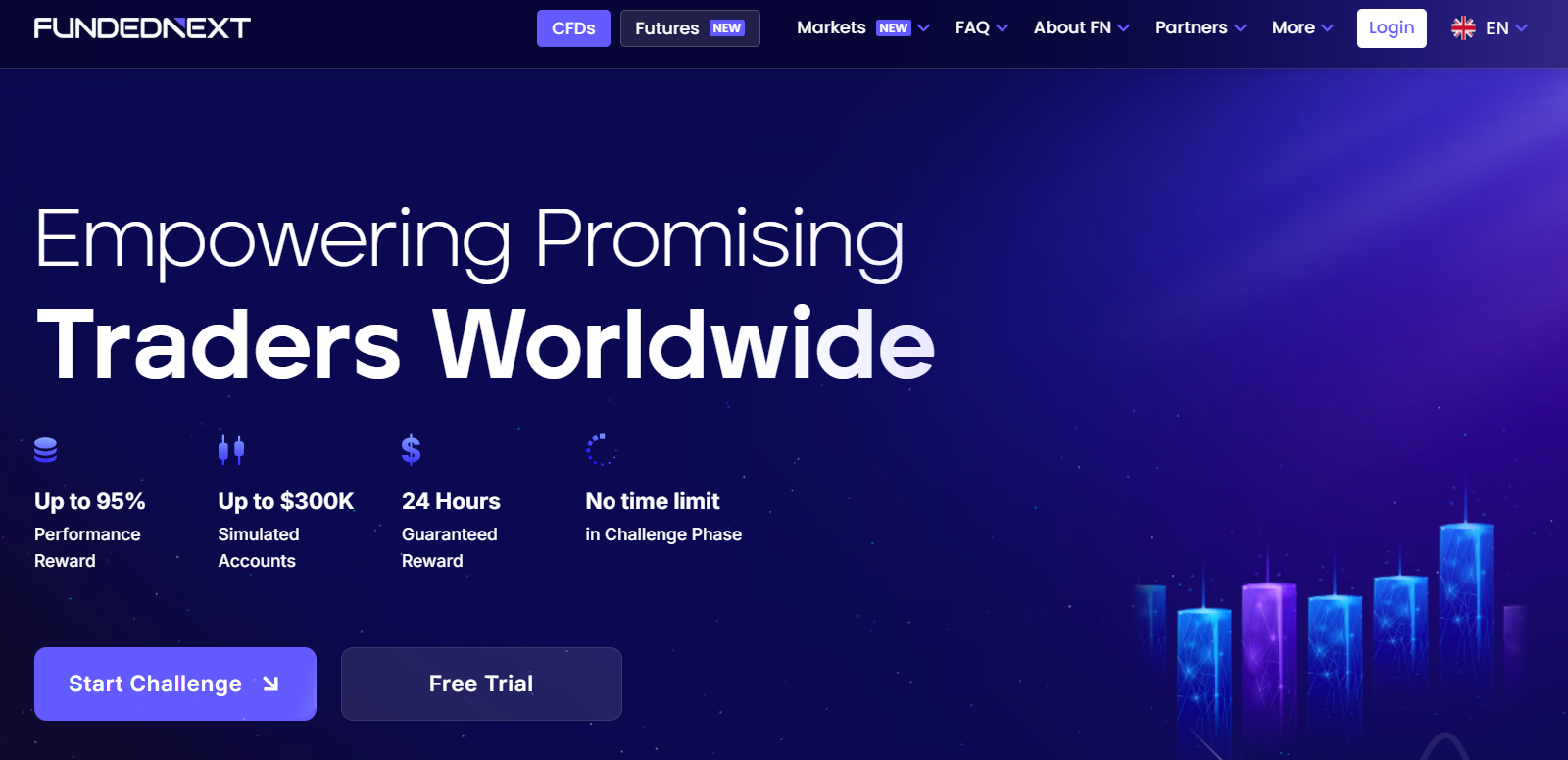
Traders seeking multiple pathway options and aggressive scaling potential up to $4 million.
Four different models (Stellar 2-Step, Stellar 1-Step, Stellar Lite, Stellar Instant), each with distinct profit targets and performance metrics. Using a balance-based drawdown calculation instead of an equity-based one gives traders more flexibility when positions temporarily move against them, since unrealized losses don't immediately trigger violations.
Up to 95% after passing the challenge phase, with 15% profit share earned during evaluation.
Earning a profit share during the challenge phase provides immediate income before funding, with a 24-hour payout guarantee to address frustrations from delayed withdrawals.
The challenge's structural complexity can overwhelm beginners unfamiliar with the four models. Founded in 2021, the platform has a relatively short operational history. Demo account trading is available throughout all phases.

Traders seeking programs ranging from beginner to advanced levels or instant funding without evaluation.
Three programs: Experienced Trader (one phase, 10% profit target, 6% max loss), Advanced Trader (two phases, 10% then 5% targets, 10% max loss both phases), Master Trader (instant funding, no evaluation). Fees range from $119 to $4,500.
80% to 100% depending on the program.
No minimum or maximum trading day requirements. Weekly payouts provide regular income.
Trade Tech instant funding eliminates evaluation for traders willing to pay higher upfront fees, and program variety suits both beginners and experienced traders.
Advanced Trader prohibits holding positions over the weekend, thereby restricting swing trading strategies. The 30:1 maximum leverage constrains position sizing, and 10% profit targets with this leverage create challenging risk-reward mathematics. Demo account trading only.

People who trade using algorithms and Expert Advisors need to modify their strategies and grow accounts up to $4 million.
Three journeys: Hyper Growth (1-step, 10% profit target, 6% max drawdown), High Stakes (2-step, 8% then 5% targets, 10% max drawdown), and Bootcamp (low-cost entry). MetaTrader 5 platform exclusively.
Up to 100%.
All trading styles are allowed, including news-based trading, overnight and weekend holds, and automated systems. Some programs offer live trading accounts instead of demo accounts at higher fee tiers.
100% profit split on certain programs means traders keep all earnings after the firm recovers costs. Strategy flexibility supports different approaches without arbitrary restrictions.
Program structure complexity can confuse newcomers. The High Stakes program with 100:1 leverage incurs steep joining fees, while the Bootcamp operates on demo accounts with 10:1 leverage, which limits flexibility in position sizing.

Forex traders seeking high profit splits and flexible evaluation timelines.
1-step or 2-step evaluation on MT4/MT5 platforms with funding scaling to $2.5 million. Traders select their evaluation path based on consistency and risk tolerance.
Up to 95%, among the highest in the industry.
There are no time limits for passing the evaluation, removing the pressure of deadlines. Expert Advisors and news trading are permitted. The drawdown calculation is based on equity.
The 95% profit split lets traders keep nearly all earnings. Evaluation flexibility allows traders to choose a pace matching their strategy development timeline.
Entry fees are relatively expensive compared to competitors. Equity-based drawdown rules can trigger violations during temporary drawdowns even when positions ultimately recover. Initial profit targets challenge newer traders, and demo account trading is required throughout.

Futures traders who need high capital access and prefer trading micro or mini contracts during evaluation.
Evaluation on micro/mini contracts, then transition to a funded account upon passing. Funding ranges from $25,000 to $300,000, with up to 20 accounts managed simultaneously.
100% of the first $25,000 per account, then 90% thereafter.
Trading is permitted during exchange holiday hours and news events. Flexible rules accommodate diverse strategy types. Supported platforms include Rithmic, Tradovate, NinjaTrader, TradingView, and 10 others.
You keep 100% of profits on the first $25,000 per account, giving you a strong incentive to trade well. You can also use multiple accounts, allowing profitable traders to work on 20 positions simultaneously.
This program works only with futures, so you cannot trade forex or other assets. Contract size limits during the test period may not match your actual trading strategy needs.
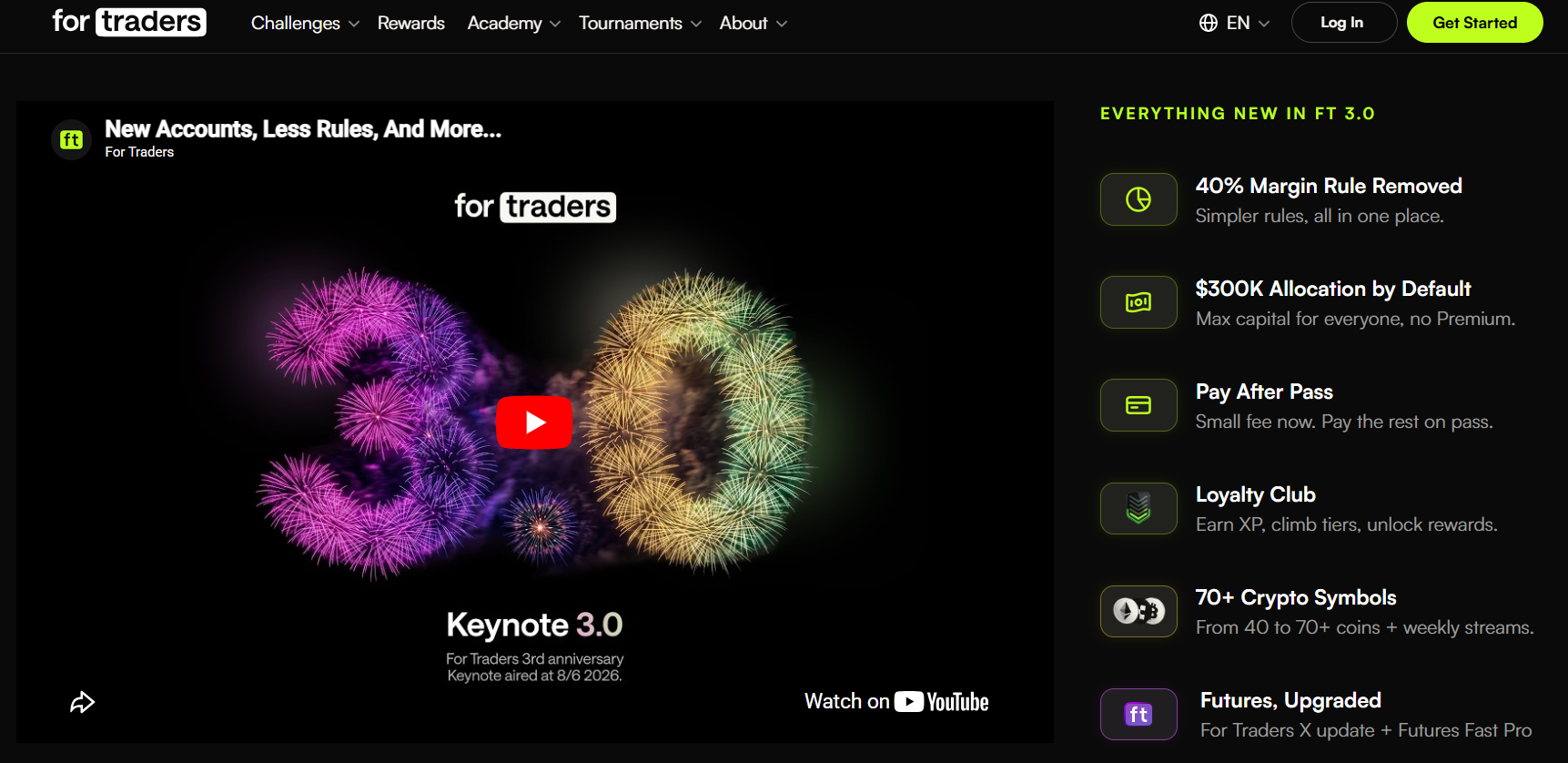
Traders who prioritize technology infrastructure, AI-powered performance analytics, and active community engagement.
Customizable challenges let traders adjust profit targets, drawdown limits, and other settings across MT5, cTrader, TradeLocker, and For Traders X (futures only). Asset classes include forex, crypto, and futures.
70% to 90% depending on the challenge parameters you select.
Trade Tech's built-in trading journal and AI coaching tools provide real-time feedback on your performance. Once you meet profit requirements, you receive payment within 48 hours.
A custom-built dashboard with AI analytics helps traders identify weaknesses in patterns and sharpen their edge. Active offline presence through events and community meetups builds trust. Over $7 million paid out since mid-2023 demonstrates operational credibility.
Newer firm with less than two years of operating history. Extensive customization options may overwhelm traders who prefer preset structures.

New traders who want to start with low costs and have time to practice.
Accounts range from $2,000 to $100,000, with entry fees starting at $23. Choose between 1-step and 2-step evaluation options on TradeLocker or cTrader.
Up to 90%.
No time limits eliminate pressure to force trades. News trading, weekend holds, and EAs are all permitted.
The $23 entry fee is the lowest barrier in the industry, making this accessible for traders with limited capital. Transparent pricing with no hidden commissions and strategy flexibility support diverse approaches.
Lower account sizes may not satisfy traders seeking larger capital allocation. Trade Tech remains relatively unknown compared to established competitors.

Traders seeking fast payouts and transparent withdrawal tracking.
1-step and 2-step evaluation for forex and futures. Futures traders pay no activation fee after passing the challenge.
Up to 95%.
1-hour payout processing eliminates delayed withdrawals. On-demand payouts for forex traders replace fixed withdrawal cycles. A live payout dashboard provides real-time visibility into withdrawal status.
The fastest payout processing in the industry at one hour. Transparent tracking eliminates uncertainty around withdrawal timelines. No activation fee for futures traders reduces total cost.
A newer firm without an extensive operational track record and limited information about the evaluation structure complexity.

Traders seeking broker-backed infrastructure, institutional liquidity, and clear scaling paths.
Multiple evaluation formats, including 1-step, 2-step, instant funding, and Phoenix program (scales from $2,500 to $2 million based on performance), backed by Moneta Markets brokerage with Tier-1 liquidity.
Up to 88%.
Unlimited time limits for challenge completion, transparent profit targets and drawdown limits with no hidden conditions, payouts every 14 days after funding, and professional trading technology matching Moneta Markets' global client infrastructure.
Broker backing provides execution quality and regulatory compliance that standalone prop firms cannot match. The Phoenix scaling program rewards consistency with capital growth to $2 million. Over a decade of brokerage experience and $150B+ monthly trading volume demonstrate operational stability.
The 88% profit split falls below competitors' offering of 90-95%. The variety of evaluation structures may confuse traders who prefer simpler options.
The firms above represent different philosophies about what traders need. Some focus on accessibility, others on technology infrastructure or execution quality. A few target scaling potential for proven traders, while others cater to beginners. The common thread is capital allocation for demonstrated skill, though the path and terms vary significantly.
Most traders fail their first evaluation because they choose a firm whose structure conflicts with their strategy. A scalper needs different drawdown flexibility than a swing trader, and an algorithmic system requires different platform support than a discretionary price-action system.
The profit split matters less than whether evaluation rules allow your actual trading behavior to succeed. When traders match their approach to the right firm's structure, passing rates improve dramatically.
But even perfect alignment between trader and firm doesn't guarantee success without understanding what happens behind the scenes once the fund is funded.
Understanding how proprietary trading firms operate shapes your choice. Most traders compare profit splits and challenge fees without asking what happens to their trades once funded, how risk systems monitor positions, or why some firms scale traders quickly while others cap them at initial allocations. The infrastructure matters more than the marketing.
🎯 Key Point: The firm's underlying technology and operational structure will directly impact your trading experience, payout reliability, and growth potential as a funded trader.

The challenge is understanding which system fits your trading style, risk tolerance, and consistency profile. A firm built on fragmented technology might offer attractive terms but struggle with payouts or performance tracking. Another might have seamless operations but evaluation rules that conflict with how you trade. The difference shows up in your experience as a trader.
"The infrastructure matters more than the marketing when choosing a proprietary trading firm." — Trade evaluation systems directly impact trader success rates and payout reliability.
⚠️ Warning: Don't choose a prop firm based solely on profit splits and fees. The underlying technology and risk management systems will determine your actual trading experience and long-term success.

Trade Tech reveals how modern prop trading systems are structured behind the scenes, from evaluation logic and risk controls to payout systems and performance tracking. Rather than choosing a firm based on surface comparisons, you can understand what separates scalable, well-structured firms from unsustainable ones.
Impact on Traders
Position monitoring, drawdown limits
Impact on Traders
Payment reliability, processing speed
Impact on Traders
Accurate P&L, transparent reporting
Impact on Traders
Fair assessment, consistent rules
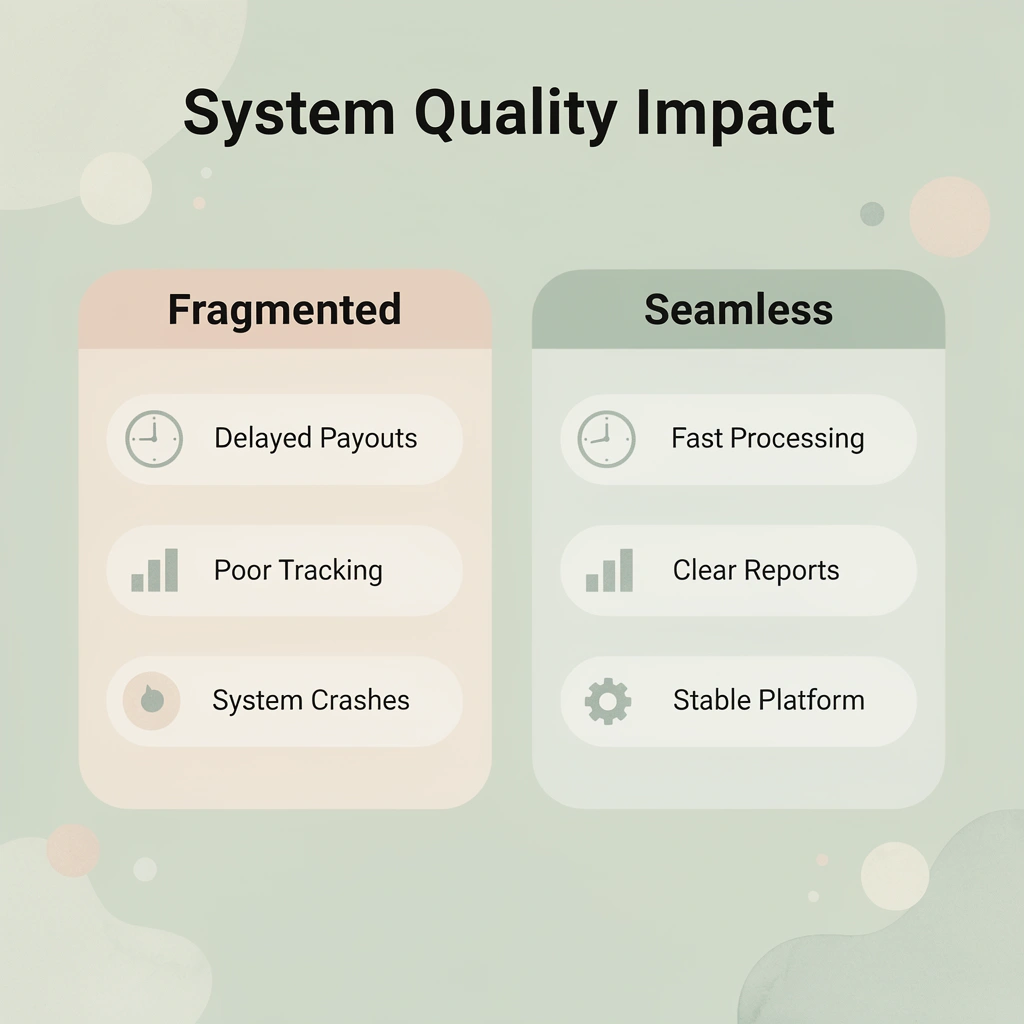
If you're serious about trading with proprietary firms, understand the system behind them first. Book a consultation to explore how proprietary trading firm systems are designed and how infrastructure impacts trader outcomes. You'll gain a clear understanding of how prop firms evaluate traders, manage risk, and structure payouts, and how those systems affect your success.


.png)
