A prop firm can offer competitive pricing, attractive profit splits, and reliable payouts yet struggle to attract customers. Sometimes, the problem is where potential buyers are looking and not the offer.
Comparison websites have become an important channel for discovery and quick reviews. For instance, a buyer with $300 to spend can filter through 60 firms, compare their trading conditions, and narrow the options to 3 within minutes.
If your firm is missing from those results, even a competitive offer may go unnoticed.
For prop firm owners, these platforms offer access to an audience already looking to compare prop firms and purchase challenges. But not every listing deserves your time or marketing budget.
Knowing which platforms attract serious buyers, how they rank firms, and what influences purchasing decisions can help you make better choices.
Below, we examine the best prop firm comparison websites, what makes them valuable, and how to turn listings into a reliable customer acquisition channel.
Why Comparison Sites Matter to Prop Firm Operators
A comparison site is a website where traders view many prop firms in one place. Nearly all show price, profit split, drawdown rules, payout terms, platforms, and reviews in one table. Traders use these tables to compare prop firms side by side before they buy, so a listing puts your offer in front of a trader who is already shopping.
3 things make these sites strong for you:
- Ready buyers: Visitors come to pick a firm, not to read about trading.
- Trust from reviews: Scores and reviews do some of the selling for you.
- Offers in plain sight: Discount codes sit next to your rules, so a clear offer wins attention.
Many of these sites are also prop firm affiliate websites. They earn a fee when a trader buys through their link or code, and several say so on their pages. This is normal, and it makes listing a sales channel as well as a brand step. It also means you should read each site's terms before you agree to anything.
What to Prepare Before You Apply
Review teams and traders look at the same things. Get these 7 ready first:
- Rules in plain words: Put profit targets, drawdown limits, payout terms, and banned tactics on one clear page. Sites compare rules line by line, so any gap looks like a risk.
- Honest account wording: State clearly how accounts work. Evaluation and funded accounts are simulated, and payouts come from the challenge fee pool.
- Payout proof: Keep records of paid requests and how long each one took. Several sites show payout data next to each firm.
- Fast support: Test your help desk before you apply. Slow answers turn into bad reviews.
- A review plan: Ask happy traders for honest reviews after a payout. Never pay for reviews or write them yourself.
- A discount plan: Decide how much you can give while your payout reserve stays safe. For better context, see our recent guide on how prop firms make money
- Compliance in place: Payment partners and listing sites both expect verified traders and clean records. Use our compliance checklist to get there.
If your firm is still in the planning stage, check out how to start a prop firm and come back when you are ready to sell.
How Listings Work on Prop Firm Affiliate Websites
Every site sets its own rules, but here are the 3 most common models:
- Apply and get vetted: The site checks your firm before it adds you.
- Add a firm form: A short form asks for your firm name and website, and the site collects the rest.
- Partner or affiliate deal: The site earns a fee on each sale made through its link or code, and it may add a Partner or Featured label.
Ask these 5 questions before you sign:
- Is there a listing fee?
- What share of each sale does the site take?
- How long does a tracking link stay active after a click?
- Can you update your own data?
- How does the site handle reviews and disputes?
You can also build your own network of promoters next to these listings. See our guide on how to get affiliates for your prop firm.
The Best Prop Firm Comparison Websites to List Your Prop Firm On
Each comparison website has its own features and approach to helping traders evaluate prop firms. Since listing requirements and terms may change, review the latest information before applying
1) TradingPilot

TradingPilot is a comparison platform built for traders who want facts before they pay. Its main table shows each firm with a TP Score, platforms, drawdown type, funding size, payout details, and a discount code.
Traders sort by popularity, trending firms, or review count. They can open a side-by-side view of fees, profit targets, drawdown rules, and payout terms.
Filters go deep. A trader can narrow firms by market, platform, news trading, weekend holding, copy trading, scalping, hedging, scaling plans, and consistency rules.
- A quiz called Prop Navigator matches a trader to firms in 2 minutes.
- A Hot Deals page lists verified discount codes, and a payout tracker shows payout data.
For you as an operator, traders arrive with a clear picture of your rules, so clean rule pages and steady reviews help your TP Score.
The site says it may receive compensation from some listed firms and says this does not change its reviews or rankings. Firms can add promo codes, which appear in the deals sections.
2) Prop Firm Match
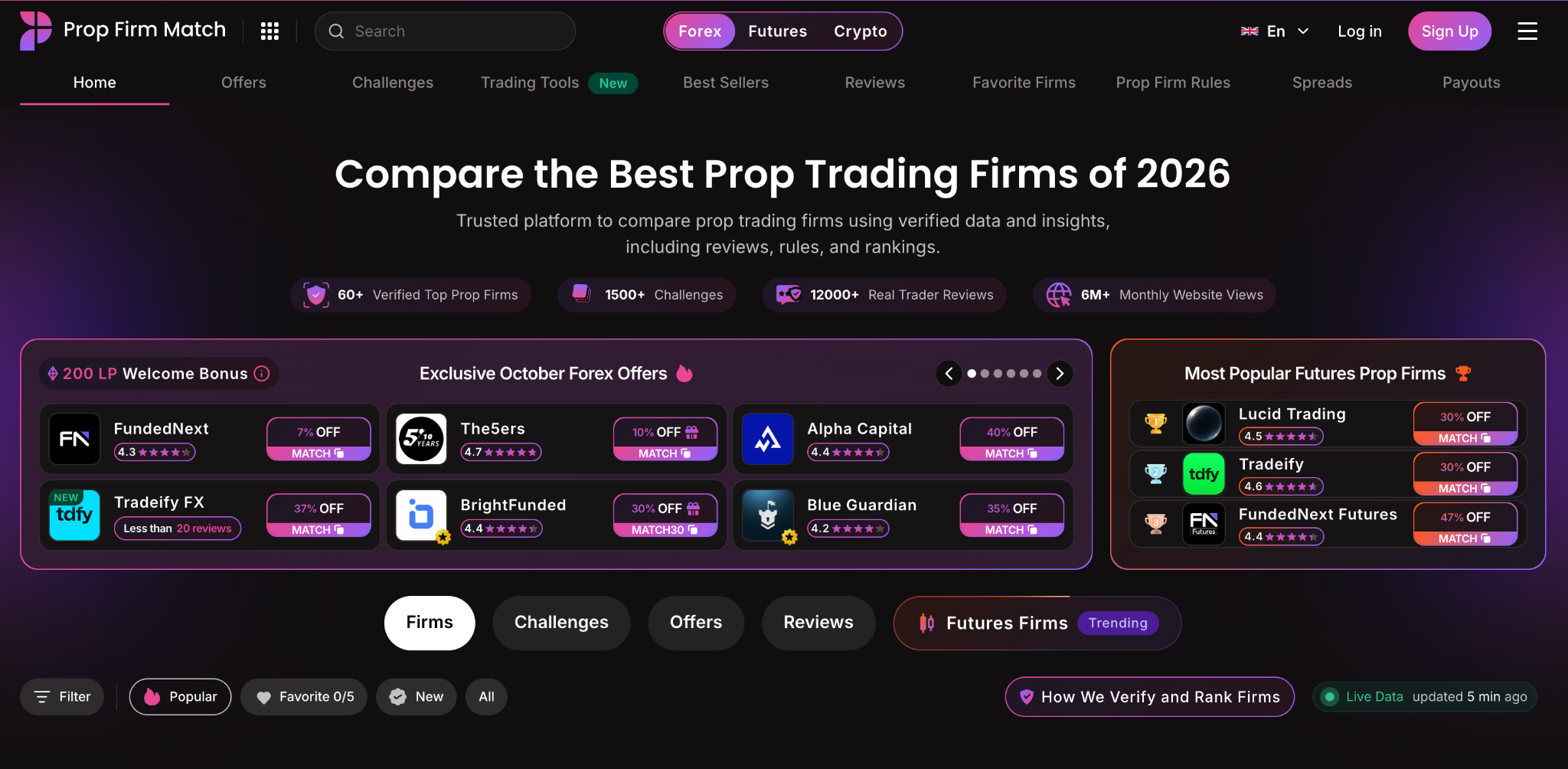
Prop Firm Match is one of the best-known names in this space. As of October 2026, the site says it lists 60+ verified firms and holds 12,000+ trader reviews. It also reports 6M+ monthly website views, which shows how much traffic a strong listing can reach over time.
Traders browse by market, which covers forex, futures, and crypto.
- A comparison table shows rank, reviews, country, years in operation, platforms, maximum allocation, and promo code.
- A challenge comparison page puts profit targets, loss limits, profit splits, and activation fees side by side. Firms are ranked by score, and the site runs best seller lists and yearly awards.
Listing is not automatic. The site says it only lists firms that pass its compliance and vetting process, and it links to a page on how it verifies and ranks firms. Operators can also apply through the List Your Prop Firm link on its business side.
Currently, the vetting rules and any fees are not shared on the page, so ask the team directly before you apply.
3) PropFirmMap
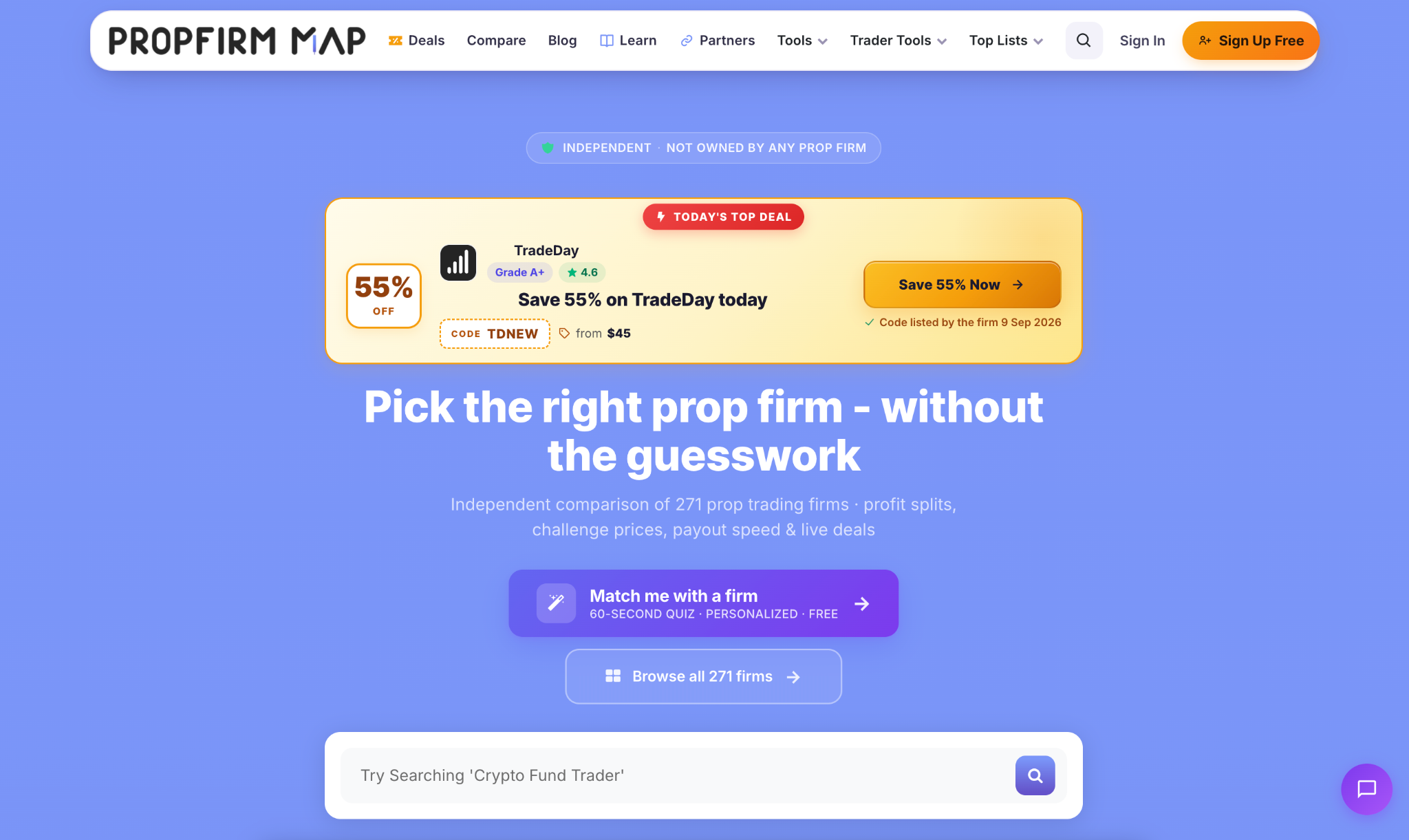
As of October 2026, PropFirmMap tracks 256 prop firms and ranks them with its own PropFirmMap Score. The score blends challenge price, profit split, drawdown rules, payout reliability, a safety grade, and Trustpilot rating and review volume.
The site says it checks figures again against each firm's website and recalculates rankings weekly. Traders sort and filter by account size, profit split, drawdown type, payout frequency, price, platform, and allowed trading rules.
- Head-to-head pages let them place 2 firms next to each other.
- Offerings include a cost calculator, a drawdown calculator, a short quiz to find a firm, and lists such as cheapest firms, fastest payouts, and best for beginners.
Firms can be added through an “Add a firm” option in the site's feedback form, which asks for a firm name and website.
Listed firms carry badges such as Verified or Partner, and the site links to a Partner Program page and an affiliate disclosure. As the score uses payout reliability and Trustpilot data, a good public record helps your rank.
4) Prop Firm Compare

Prop Firm Compare focuses on futures prop firms. This suits a market where small rule details, such as trailing drawdown, decide who passes. In July 2026, it launched a new comparison engine built to show many firms side by side on one standard set of data points.
The goal is to expose rule differences hidden by big account sizes and promotions. Traders can filter by needs, such as firms with no consistency rule or with faster payouts.
- Fields cover challenge fees, one-step, two-step, and instant funding options, daily and overall drawdown limits, and trailing drawdown methods.
- Other details include profit splits, payout frequency, activation fees, contract limits, trading platforms, discount codes, and scaling plans.
Each firm gets a profile with details on its process, pricing, rules, and payouts.
The announcement does not explain how firms are chosen or ranked. If you run a futures firm, contact the team and ask how to submit your data.
Quick View of the 4 Sites
Use this table to see where each site fits. It sums up the best prop firm comparison websites covered above.
How to Choose Where to List
Choosing the best prop firm comparison websites requires more than looking at their popularity. Focus on platforms that align with your firm's offerings, target audience, and business goals.
The following criteria will help you decide where to list your firm first:
- Match your market: A futures firm gains more from a futures-focused site, while a forex firm needs strong forex filters.
- Check the audience: Ask each site for traffic and sales data, and treat figures on its pages as claims until they send proof.
- Read the terms: Look at fees, sale share, tracking time, and who controls your data.
- Start with 2: Traders compare prop firms on several sites, so pick 2 that fit your market, learn what works, and then add more.
- Review each month: Keep the sites which send paying traders and drop the rest.
Make Each Listing Pay Off
A listing on any of the best prop firm comparison websites only starts the work. Traders who click through will judge your site, rules, and support system in minutes.
- Tag every sale: Give each site its own code or link, and store the source in your back office so you can see which listing pays.
- Answer reviews: Reply to good and bad reviews with facts and a fix, not an argument.
- Keep data fresh: When you change a rule or a price, update every listing the same day.
- Keep traders coming back: A trader who resets, upgrades, or refers a friend adds revenue at a low cost, while a new trader needs a full acquisition spend. Check out our guide on trader analytics and retention to see how.
Get Listing Ready With the Right Tech
The best prop firm comparison websites reward firms with clean rules, fast payouts, and quick support, and all three depend on the tech behind your firm. Trade Tech Solutions (TTS) is a technology partner for prop firm operators. So far, we have supported 85+ prop firms across 180+ regions.
Firms using our infrastructure serve 2M+ users and 1M+ active accounts every month, generating more than $200 million in client revenues each year. To date, they have also processed over $100 million in trader payouts.
One connected system brings together these parts:
- Rules and challenge setup your team can change without a developer.
- Automatic rule checks and risk dashboards.
- Payments across 80+ payment processors.
- Links to 20+ trading platforms.
- Reports to track sales by source.
TTS powers many of the top 15 prop firms in CFD and futures, including Goat Funded Trader and Goat Funded Futures, alongside Aqua Funded, BluSky, TX3 Forex and TX3 Futures, and Finotive Futures. A new firm can go live in as little as 7 days. Firms moving from another provider can migrate in as little as 48 hours.
Book a consultation with the TTS technical team to get your rules, semi-automated payouts, and tracking ready before you apply to your first listing.
Frequently Asked Questions
Should a brand-new prop firm apply to comparison sites right away?
It's better to wait until your trading rules are stable and you've processed your first payouts. Comparison websites and potential customers often look for evidence of reliability before trusting a new firm. Listing too early, without a proven track record, can attract poor reviews and make it harder to build credibility.
How big a discount should a prop firm offer on a comparison site?
There is no fixed percentage. Your discount should depend on challenge pricing, pass rates, operating costs, and payout reserves. Calculate the lowest price your firm can charge while remaining profitable, then ensure the discounted price stays above this amount. A larger discount isn't worthwhile if it puts pressure on your finances.
How can a prop firm track which comparison site a sale came from?
Assign a unique referral link or discount code to each comparison website and record the source during checkout. Your back-office system can then connect purchases, challenge resets, and payouts to individual platforms. This helps you identify which listings generate sales and bring in customers who remain active.
Do traders from comparison sites ask if accounts are simulated?
Yes, some may want to understand how funded accounts and payouts work before purchasing a challenge. Explain clearly on your website and comparison listings that evaluation and funded accounts use simulated capital, while eligible traders receive payouts from the firm. These payments are funded through company revenue, including challenge fees.
Can a prop firm remove a bad review from a comparison site?
Review removal depends on the website's moderation policy. A negative review cannot usually be removed simply because your firm disagrees with it. The better approach is to respond professionally, address the complaint, and encourage the customer to update their review after resolving the issue. Review each platform's policies before listing.