
Picking the best forex CRM for prop firms is one of the biggest technology decisions a funding brand will ever make. Everything else, such as challenge sales, trader dashboards, risk checks, and payouts, sits on top of it. Get the CRM right, and the rest of the business runs smoothly; otherwise, every part of the business feels the strain.
At Trade Tech Solutions (TTS), we build the technology that powers this exact layer for a number of the prop firms named in this guide. This guide explains what a forex CRM is, how it connects to a prop firm's daily operations, and what to look for if you are choosing one for your own firm.
What Is Forex CRM Software?
Forex CRM is not a regular sales CRM with a trading logo added to it. It is software built to sit between the trading platform a client trades on (MT5, cTrader, MatchTrader, NinjaTrader, Tradovate, and others) and every task a broker or prop firm needs to run day-to-day.
- General CRMs track leads and deals.
- Best forex crm for prop firms track live trading accounts, real balances, rule breaches, and profit splits, all connected to systems that move real money.
It is made up of several parts working together:
- Trader's room: The screen a trader logs into. Here they buy a challenge, track their progress against profit targets and drawdown limits, and request a payout.
- Back office: The internal panel used by support, risk, and compliance staff. This is where a team member looks up an account, sees why a rule was flagged, and approves a payout.
- Trading platform connection: The technical link between the CRM and the trading servers themselves. This is what lets the CRM see live trades and account balances as they happen, not on a delay.
- IB and affiliate system: Tracks referral trees and works out commission across multiple tiers automatically.
- Payment and payout rails: Connections to card processors, crypto gateways, and bank transfer providers, used for both challenge purchases and trader payouts.
- KYC and compliance layer: Identity checks and document verification, usually required before a trader can withdraw funds.
- Rule checking system: Watches every account against its own rule set (daily loss limit, max drawdown, consistency rule) and flags or closes accounts that break the rules.
- Reporting: Dashboards for the firm's own team, covering pass rates, revenue, and payout volume.
Every one of these parts has to work with the others, in real time, for a prop firm to run smoothly. This is why choosing the best forex CRM is always a foundational decision.
How a Forex CRM Connects to a Prop Firm's Daily Operations
It helps to walk through what happens behind the scenes, from the moment a trader buys a challenge to when payment is made.
- Challenge purchase: A trader picks an account size and rule set on the firm's website. The CRM records the payment, applies any discount code, and starts the account setup.
- Account setup: The CRM creates a trading account on the platform the firm supports and assigns the correct rule set to it. A firm running several different rule sets at once needs this step to be exact every time.
- Live rule monitoring: From the first trade, the CRM checks the account against its daily loss limit and max drawdown. This runs continuously, not once a day, so a breach can be caught the moment it happens.
- Pass or breach: Once a trader hits the profit target while staying inside the rules, the CRM moves the account forward. If a rule is broken first, the account closes, and the reason is logged for the trader to see.
- Identity check: Before money moves, a lot of firms require identity verification. The CRM's KYC layer checks documents and clears the trader for payout.
- Funded account setup: A new account is created, carrying funded stage rules, which are often different from evaluation rules.
- Payout: When a trader asks for a payout, the CRM works out the split based on that trader's plan, then sends the payment through crypto, bank transfer, or another payout method.
- Affiliate commission: If the trader came through a referral link, the CRM works out the referring partner's commission at the same time.
- Reporting: Every purchase, pass, breach, and payout feeds back into dashboards the firm's own team uses to track the business.
The full process runs through the CRM. Any weak point, from slow account setup to delayed rule checks or payouts, can directly affect traders through missed challenges, incorrect flags, or late payments.
What to Look For in a Forex CRM for Prop Firms
With that full picture in mind, here is what separates the best forex crm for prop firms from a weak one. These are the same standards we build to at Trade Tech Solutions.
- Rule flexibility: Can it run several different challenge types at once, static drawdown on one, trailing drawdown on another, without custom coding every time a new product launches?
- Platform coverage: Support for MT4, MT5, and a modern web platform like MatchTrader on the forex side, plus NinjaTrader or Tradovate on the futures side.
- Semi automated payouts: Biweekly, weekly, or on-demand payout cycles that run with manual approval.
- Accurate affiliate tracking: Multi-tier commission math that stays correct at real volume.
- Fast breach detection: How quickly the system reacts to a live drawdown breach, since a delay here costs trader trust.
- Built-in KYC: Identity checks built into the flow rather than bolted on as a separate tool.
- Real scale: A CRM proven at millions of accounts behaves very differently from one only tested at a small scale.
- Clear reporting: Real numbers on pass rates and revenue per product, not just a basic activity log.
Case Studies: Platforms Running on TTS Technology
Here is how 8 firms in the prop trading and futures funding space are built, what they offer traders, and how they run on our CRM technology.
1) Aqua Funded
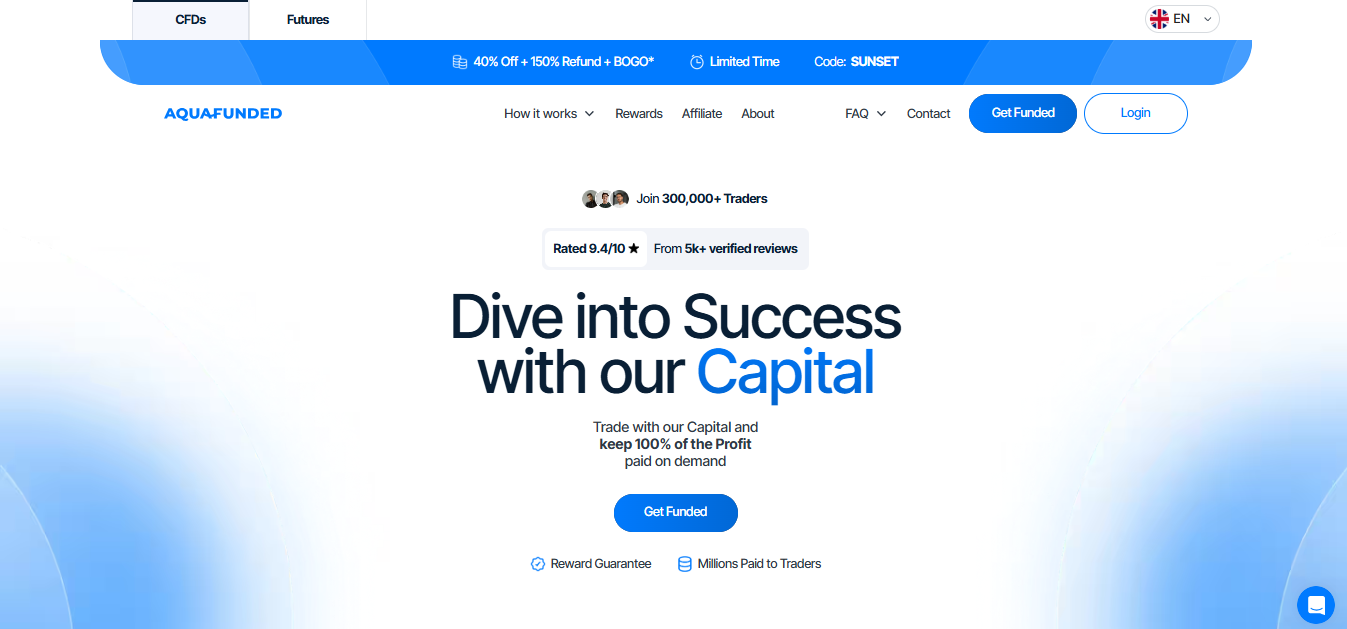
Aqua Funded is a Dubai-based prop firm launched in December 2023, part of the wider Aqua Funds group. Traders can choose instant funding or a 1, 2, or 3-step evaluation path, with account sizes from $2,500 up to $400,000 and scaling advertised to $4,000,000. The CRM behind Aqua Funded runs 4 trading platforms and manages profit splits from 90% up to 100%. This comes along with a career tier program layered on top of the standard evaluations.
2) Aqua Futures

Aqua Futures is the futures-focused sibling to Aqua Funded, also part of the Aqua Funds group and built out in 2023. Traders choose between a 1-step evaluation or instant funding on Standard and Pro tiers, trading on Tradovate or Volumetrica. Its CRM applies a tiered profit split automatically: 100% on the first $15,000 in profit and 90% after that, with weekly payouts backed by a 24-hour guarantee.
3) BluSky
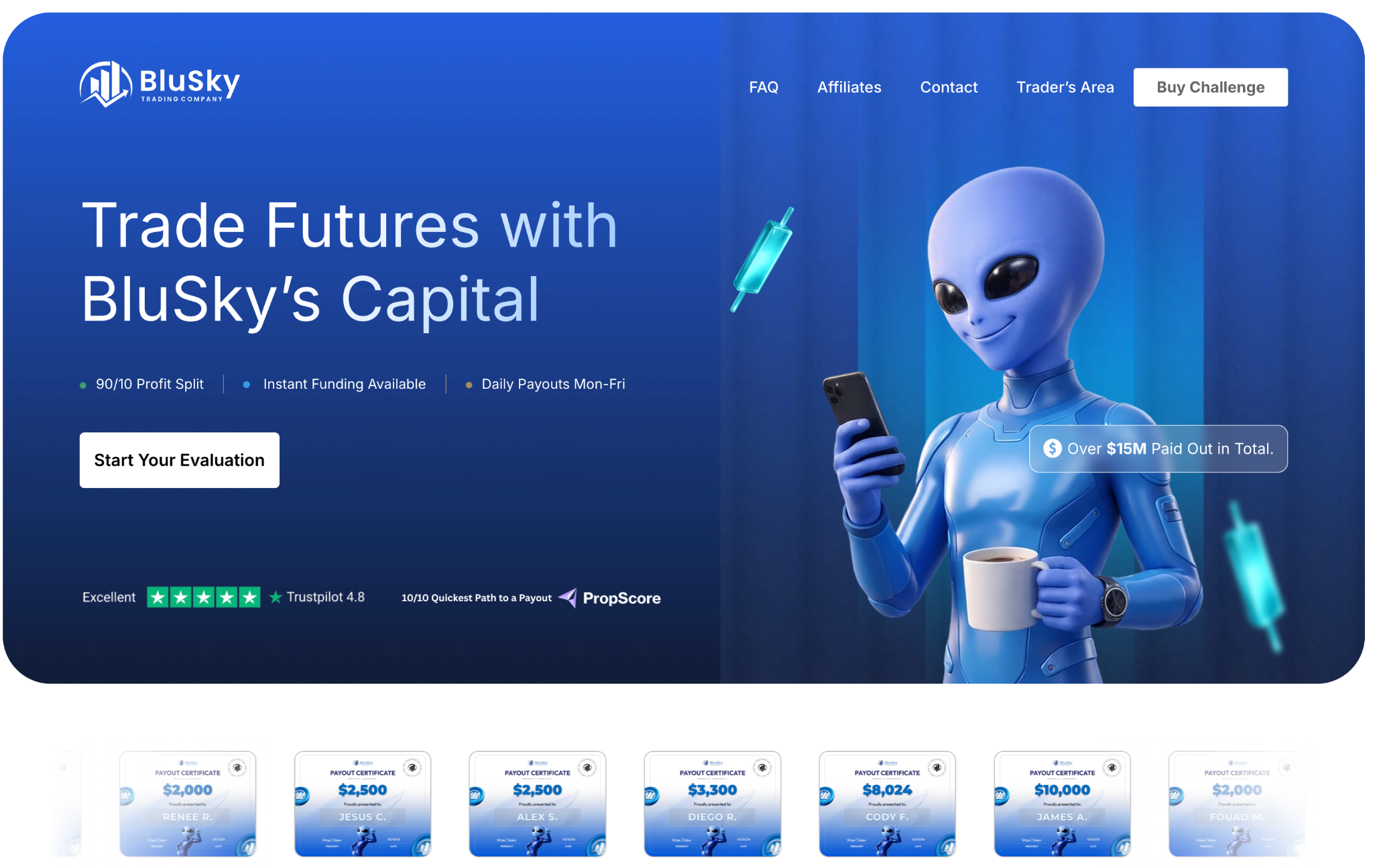
BluSky is a US-based futures prop firm founded in 2022 and based in St. Petersburg, Florida. Traders can choose from 4 funding paths, from a low-cost evaluation to a same-day Direct to Funded option, with account sizes from $25,000 to $300,000 and profit splits up to 90%. Its CRM connects to 7 execution platforms at once, including NinjaTrader, Tradovate, and Rithmic, and processes daily payouts Monday through Friday with same-day bank transfer.
4) TX3 Forex
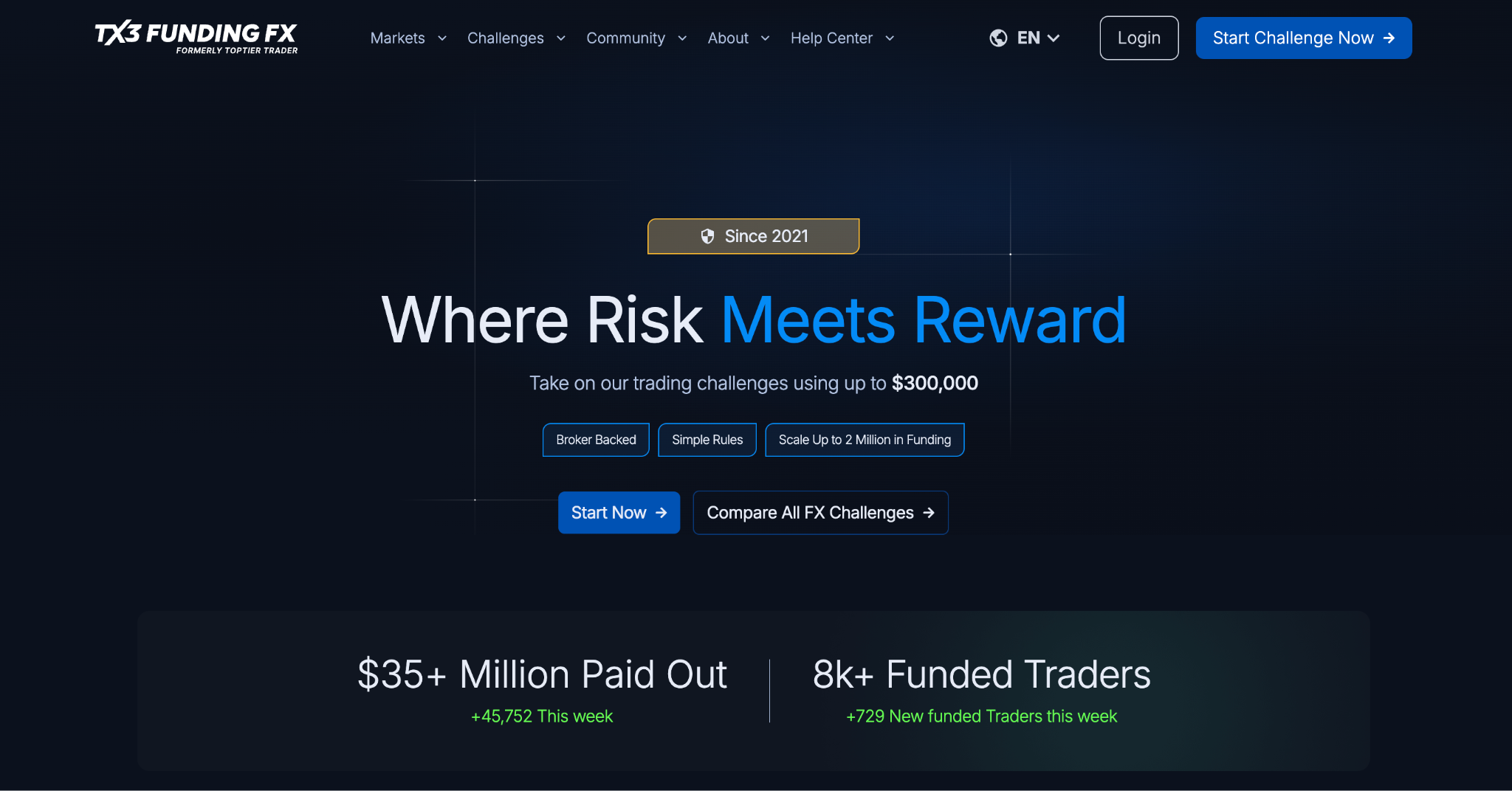
TX3 Forex is the forex side of TX3 Funding, a firm founded in 2021 that rebranded in September 2025 while keeping every existing account in place. Traders choose between 1-phase, 2-phase, or instant funding, trading on MatchTrader or MT5, with account sizes up to $300,000 and scaling to $2,000,000. Its CRM has processed payouts to more than 8,000 funded traders under this rule structure, with profit splits reaching up to 90%.
5) TX3 Futures
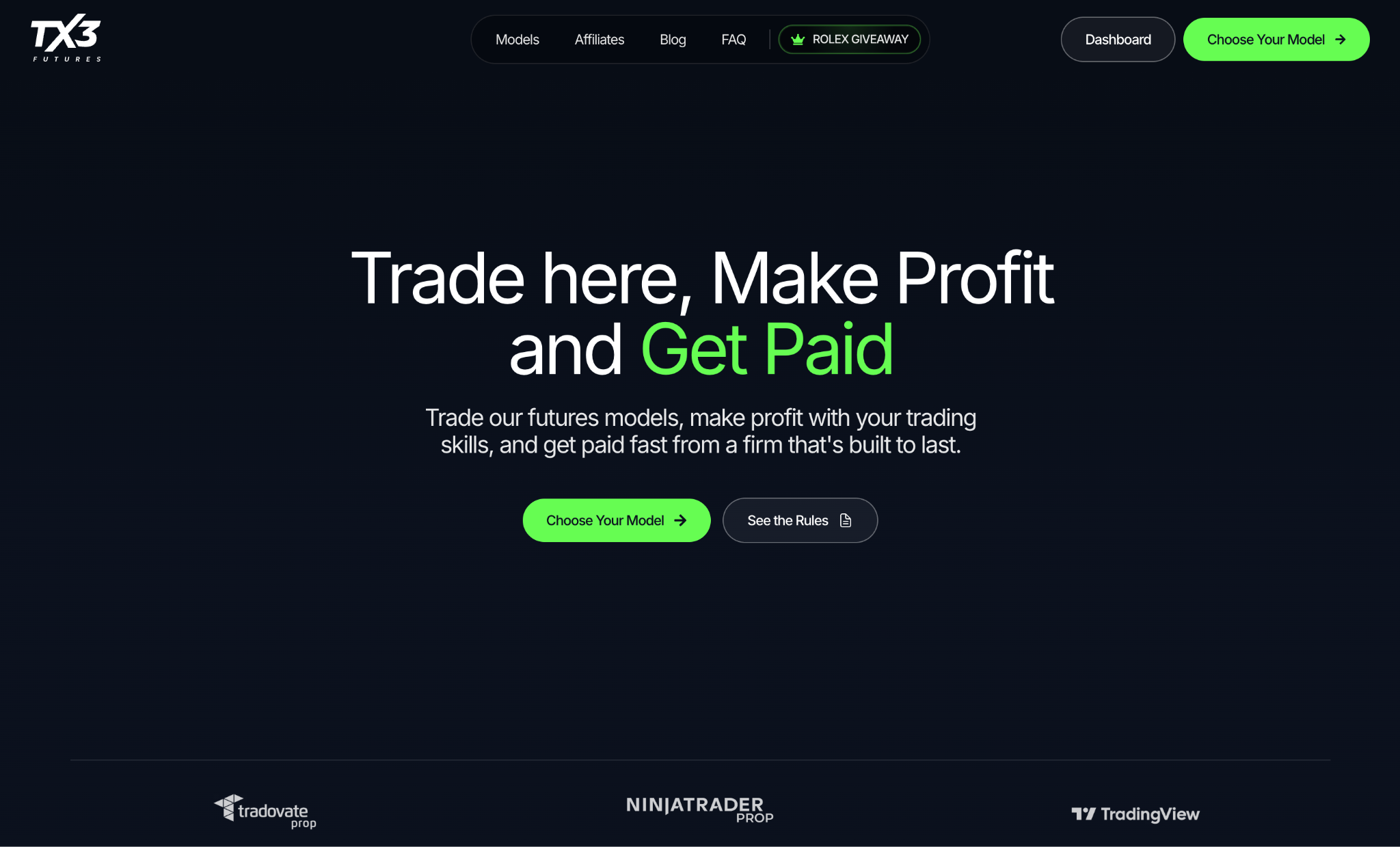
TX3 Futures is the futures side of TX3 Funding, running on ProjectX-powered accounts through Tradovate, NinjaTrader, and TradingView. Traders pick a 1-phase evaluation across $50,000, $100,000, or $150,000 accounts, under one of 3 model types with its own drawdown and payout rules. Its CRM handles payout timing that ranges from every 3 days up to on demand for its top tier, with splits up to 90%.
6) Finotive Futures
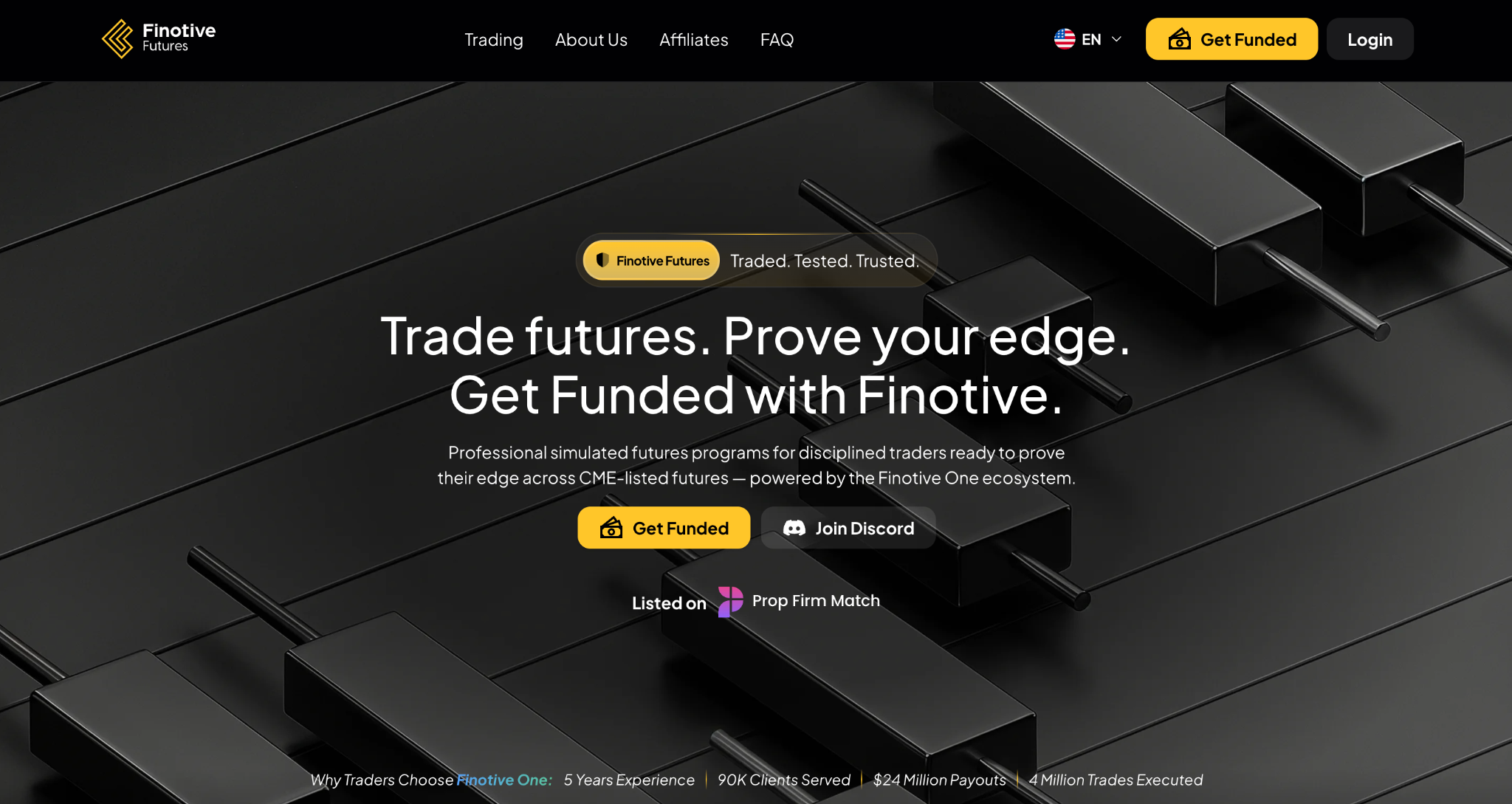
Finotive Futures launched in January 2026 as the futures product inside the wider Finotive group, which also runs a forex challenge brand out of Budapest. Traders choose a 1-step challenge or instant funding, across accounts from $25,000 to $150,000, both paying up to 90% on demand. Its CRM tracks a consistency rule and a minimum profitable days requirement together in real time, across 6 connected platforms including NinjaTrader, Quantower, and TradingView.
7) Goat Funded Futures
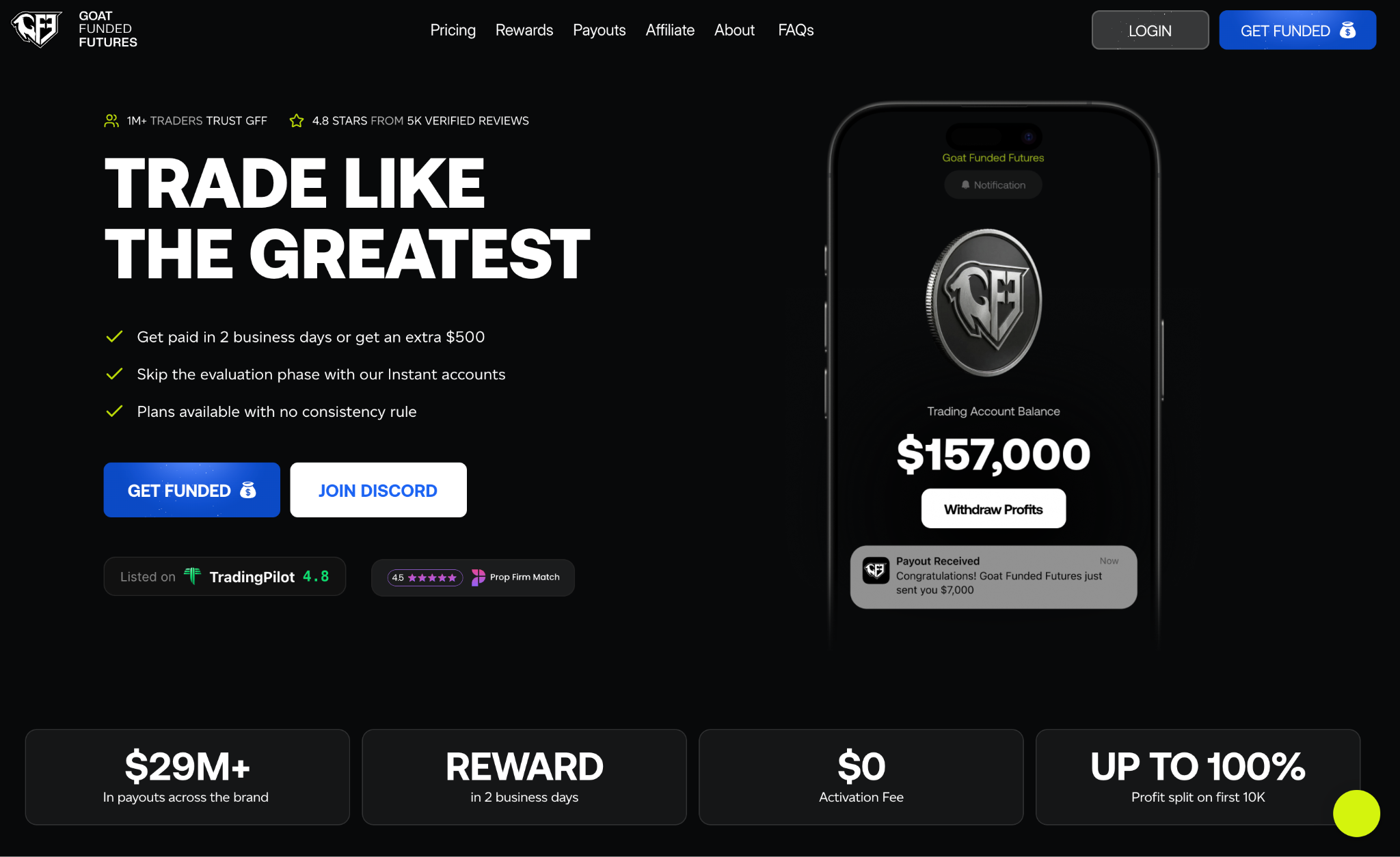
GoatFunded Futures (GFF), is the futures brand from the team behind Goat Funded Trader, built for CME, CBOT, COMEX, and NYMEX markets. Traders choose from accounts scaling up to $750,000 across 6 connected platforms, including NinjaTrader, Tradovate, and DeepCharts. Also, there is no activation fee once a trader clears the evaluation.
Its CRM switches a trader's profit split automatically once they pass $10,000 in profit, moving them up to a 100% split on that first tier. GFF runs on its own separate infrastructure from GFT, so no account data crosses between the two brands.
8) Goat Funded Trader
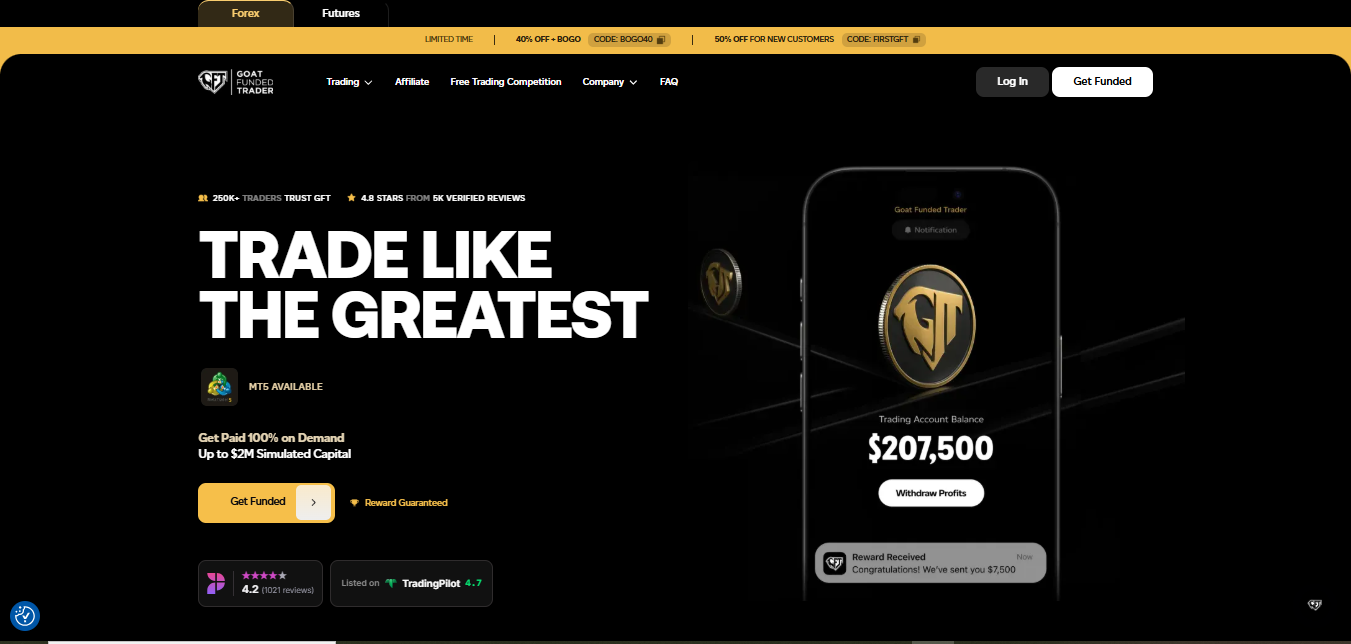
Goat Funded Trader (GFT), runs 5 named funding routes across 1-step, 2-step, and Instant Funding tiers, for 6 rule set configurations once every variant is counted. Traders choose the route that fits them, from Instant HERO's 90% profit split, the highest on the platform, to Instant PREMIUM, which removes the consistency rule entirely.
GFT’s CRM applies static drawdown during the evaluation stage and trailing drawdown at the Instant stage. The trailing figure resets after each payout, and our CRM structure keeps these drawdown rules aligned with the correct account stage.
Every account on the platform, evaluation and funded, runs as a simulated environment, with payouts drawn from the challenge fee pool rather than live market capital.
Comparison Table At A Glance
Built by Trade Tech Solutions
Over 85 prop firms run on Trade Tech Solutions technology, including several of the firms featured above. Together, firms using our CRM serve more than 2 million users and manage over 1 million active accounts each month.
They also process more than $200 million in revenue per year, while over $100 million in trader payouts has been handled through the infrastructure to date. Those numbers reflect the scale the platform is already supporting across account management, payments, risk controls, and payouts.
For a founder, the CRM is not just a back-office tool. It shapes how quickly accounts are created, how accurately trading rules are applied, how smoothly payouts are handled, and how traders experience the firm day to day.
If you are launching a prop firm or considering a new CRM provider, get in touch with our team to see how your operation could run on our infrastructure.
Frequently Asked Questions
What makes a CRM suitable for prop firms rather than retail brokers?
The best forex crm for prop firms tracks evaluation progress, profit targets, drawdowns, daily loss rules, breaches, payouts, and profit splits across different account types. Retail broker CRMs focus more on deposits, withdrawals, and live trading accounts. Trade Tech Solutions is built around the full prop firm account lifecycle instead.
Do prop firms build their own CRM or use an existing platform?
Both approaches are common. Some firms build their own CRM, but this takes more development time, maintenance, and technical resources. Others use established infrastructure like TTS to launch faster and avoid rebuilding account provisioning, risk rules, payment flows, trader dashboards, and payout systems from scratch.
Is a prop firm CRM provider the same as a broker?
No. A CRM provider supplies the software used to manage accounts, rules, dashboards, payments, and trader activity. A broker provides trading infrastructure and execution. In many prop firm models, funded-stage accounts remain simulated, while the CRM continues to track performance and payout eligibility.
How many trading platforms should a forex CRM support?
There is no fixed number. The right setup depends on the markets and traders a firm plans to serve. Forex operators may need MT4, MT5, MatchTrader, cTrader, or TradeLocker, while futures firms may also require NinjaTrader or Tradovate. Our platform supports multiple platform integrations.
Why do several prop firms use the same CRM provider?
Building prop firm infrastructure internally can be expensive and slow. A CRM must handle account creation, payments, risk rules, trader monitoring, and payouts reliably. Using our established infrastructure, prop firms can launch and scale faster while still configuring their own branding, account structures, and trading rules.

.png)
